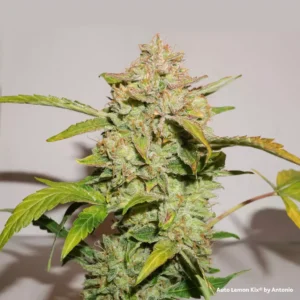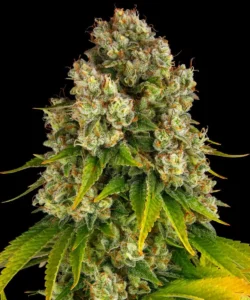


Hulkberry is a sativa-dominant feminized strain from Royal Queen Seeds created by crossing OG Kush with Strawberry Diesel. Also known by Royal Queen Seeds as Bruce Banner or OG Banner, the Hulkberry strain combines strong vertical growth, heavy resin production, high THC potential, and a citrus-diesel flavor profile.
Royal Queen Seeds classifies Hulkberry as 65% Sativa and 35% Indica. Indoors, plants typically reach 80–140 cm and flower for 60–70 days, while outdoor plants can grow to 160–200 cm and are normally ready around late September. Its relatively strong stretch means indoor growers should plan canopy height before flowering rather than waiting until the plant has nearly reached the light.
Recommended Strains
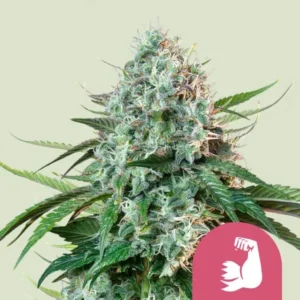
Hulkberry

|
THC | 26% - 27% (High) |

|
Lineage | OG Kush x Strawberry Diesel |

|
Type | Feminized |

|
Height | 5.91 ft | 1.8 m |

|
Yield | Medium |

|
Yield Indoor | 1.31 - 1.47 oz/ft² | 400 - 450 g/m² |

|
Yield Outdoor | 22.93 - 24.69 oz/plant | 650 - 700 g/plant |

|
Flowering Time | 9 - 11 weeks |

|
Phenotype | 35% Indica / 65% Sativa |

|
Effects | Focused, Uplifted |

|
Flavors | Citrus, Diesel, Herbal |
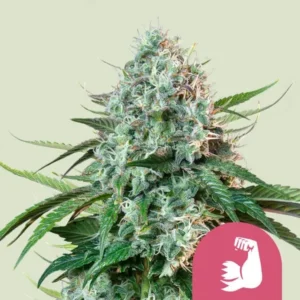
Hulkberry Auto
|
|
THC | 20% - 21% (Medium) |
|
|
Lineage | Hulkberry x Diesel Auto |
|
|
Type | Autoflowering |
|
|
Height | 3.28 ft | 1 m |
|
|
Yield | High |
|
|
Yield Indoor | 1.47 - 1.64 oz/ft² | 450 - 500 g/m² |
|
|
Yield Outdoor | 3.53 - 5.29 oz/plant | 100 - 150 g/plant |
|
|
Life Cycle | 6 - 7 weeks |
|
|
Phenotype | 30% Indica / 65% Sativa / 5% Ruderalis |
|
|
Effects | Focused, Uplifted |
|
|
Flavors | Citrus, Diesel, Fruity |
You can find the feminized Hulkberry seeds available at Growlantis.
Hulkberry Quick Grow Profile
| Trait | Hulkberry |
|---|---|
| Breeder | Royal Queen Seeds |
| Genetics | OG Kush × Strawberry Diesel |
| Seed type | Feminized photoperiod |
| Sativa / Indica | 65% Sativa / 35% Indica |
| THC | Up to 27% in the current breeder data sheet |
| CBD | Low |
| Indoor flowering | 60–70 days |
| Indoor height | 80–140 cm |
| Indoor yield | 400–450 g/m² |
| Outdoor height | 160–200 cm |
| Outdoor yield | 650–700 g/plant |
| Outdoor harvest | Late September |
| Climate | Suitable for short summers |
| Flavor | Citrus, diesel, herbal, pepper |
| Reported effects | Clear, uplifting |
These specifications refer specifically to the Hulkberry bred by Royal Queen Seeds.
Hulkberry Genetics and Plant Structure
Hulkberry combines OG Kush with Strawberry Diesel, giving the cultivar a mix of Kush-style flower density and Strawberry Diesel’s stronger sativa influence. Royal Queen Seeds describes its version as closely associated with the Bruce Banner #3 phenotype, although more balanced and Strawberry Diesel-leaning phenotypes can also appear.
This phenotype variation is important for growers because not every Hulkberry plant will develop an identical structure. Some plants can retain more of the compact, resin-heavy OG Kush characteristics, while others may stretch more strongly and show a more obvious Strawberry Diesel influence.
Indoors, Royal Queen Seeds lists Hulkberry at approximately 80–140 cm. Outdoors, plants can reach 160–200 cm, especially when given a longer vegetative period and unrestricted root space.
The cultivar can stretch significantly once flowering begins, and the developing colas continue to lengthen and swell through the early bloom period. Indoor growers should therefore leave enough headroom rather than filling the entire vertical space during vegetation.
Growers interested in one of Hulkberry’s direct parents can also see the Growlantis OG Kush grow guide.
Growing Hulkberry Indoors
Hulkberry can be grown successfully indoors despite its sativa dominance, but its stretch deserves more attention than its final breeder-listed height might suggest. A plant that enters flowering at an already excessive height can become difficult to manage during the first weeks of bloom.
An 18/6 light schedule is a common option during vegetative growth. Once the plant has developed enough structure for the available grow space, switching to 12 hours of light and 12 hours of uninterrupted darkness initiates flowering.
There is no fixed vegetative period that every Hulkberry plant needs to follow. A smaller tent may require earlier flowering, while growers with more vertical and horizontal space can allow a longer vegetative phase before the switch.
The safest approach is to base the decision on actual plant size, branch development, and available headroom rather than an arbitrary week number.
Training Hulkberry for Better Canopy Control
Royal Queen Seeds specifically highlights Hulkberry as suitable for both Sea of Green and Screen of Green cultivation. Its branching and flowering stretch make canopy management particularly useful when several plants share the same indoor space.
Low-stress training can help spread longer branches horizontally before they dominate the canopy. Topping can also be used during healthy vegetative growth when the goal is to create several strong main branches instead of allowing a single central stem to remain dominant.
ScrOG can be especially useful because it allows the grower to distribute Hulkberry’s stretching branches across the available area. The goal should be an even canopy with good light exposure rather than a tightly packed screen with poor airflow.
Avoid aggressive structural work once flowers are well developed. Major branch manipulation is easier and less disruptive when completed during vegetation or the earliest part of the flowering transition.
Light and Vertical Space
There is no single correct lamp wattage or fixture distance for Hulkberry because LED systems vary substantially in intensity and efficiency. Follow the lighting manufacturer’s recommendations and adjust according to canopy response rather than applying a universal distance.
The most important strain-specific consideration is vertical planning. Hulkberry can continue stretching after the transition to 12/12, so leave enough distance between the top of the canopy and the lighting system before flowering begins.
If one or two branches begin growing substantially higher than the rest, repositioning them early is generally more practical than waiting until late flower when the stems are carrying dense, resinous buds.
Growing Hulkberry Outdoors
Royal Queen Seeds lists Hulkberry as suitable for short summers, with outdoor plants typically reaching approximately 160–200 cm and finishing around late September.
This relatively early outdoor harvest is useful in regions where autumn weather becomes unstable before many long-flowering sativa cultivars have finished. Even so, growers should consider local temperatures, rainfall, and humidity rather than relying on the calendar alone.
Choose an outdoor location with strong direct sunlight and enough lateral space for the plant’s branches to expand. Good drainage is important because a large outdoor plant can consume substantial amounts of water while still performing poorly if the root zone remains permanently saturated.
Royal Queen Seeds lists outdoor yields of approximately 650–700 g per plant under favorable conditions. Those figures represent genetic potential rather than a guaranteed harvest. Sunlight, root volume, soil quality, watering, plant health, training, and phenotype all affect final production.
As flowering progresses, heavy colas may benefit from support if branches begin leaning under their weight. Stakes or a suitable trellis can help maintain flower position without allowing loaded branches to collapse into neighboring growth.

Hulkberry Flowering Time
Royal Queen Seeds currently lists Hulkberry at 60–70 days of indoor flowering, which corresponds to roughly nine to ten weeks after the flowering cycle begins.
The breeder’s descriptive material also refers to approximately 9–10 weeks of flowering, so the current 60–70 day specification is a good reference for indoor planning.
This period does not include germination or vegetative growth. Hulkberry is a photoperiod strain, so the total seed-to-harvest cycle changes depending on how long the grower keeps the plant in vegetation before switching to 12/12.
During early flowering, expect considerable structural development while bud sites form. Midway through bloom, the colas begin gaining more mass and resin. During the later stages, berry, fuel, citrus, and herbal aromas become increasingly noticeable as the flowers mature.
For a broader explanation of cannabis development through bloom, see the Growlantis guide to the cannabis flowering stage week by week.
Hulkberry Yield Indoors and Outdoors
Royal Queen Seeds lists Hulkberry indoor production at approximately 400–450 g/m². Outdoors, the breeder gives a range of 650–700 g per plant under favorable conditions.
These figures are more useful as a reference for the cultivar’s potential than as a prediction of what every grow will produce. Indoor yield depends on canopy size, lighting, vegetative development, root volume, plant density, environment, nutrition, and plant health.
Outdoor yield varies even more because individual plants can receive very different amounts of sunlight and root space. A Hulkberry plant grown directly in well-prepared ground under full sun can develop much more extensively than a plant kept in a relatively small container.
Training may improve how efficiently the plant uses available light, but no technique automatically guarantees a larger harvest. Healthy roots, stable environmental conditions, and an open productive canopy matter more than simply applying multiple advanced training methods.
Germinating Hulkberry Seeds
Hulkberry does not require a unique germination method. The priorities are stable warmth, consistent moisture, and enough oxygen around the seed as the root emerges.
The paper towel method is one option, while seeds can also be started directly in an appropriate propagation medium. Avoid keeping the seed permanently soaked after germination begins, as excessive moisture around the emerging root can create unfavorable conditions.
Once the root appears, handle it carefully and transfer the seed without touching or damaging the root tip. Early seedlings should focus on root establishment and the development of their first true leaves before receiving aggressive feeding.
For a detailed explanation of germination timing and methods, see how long cannabis seeds take to germinate.
Hulkberry Vegetative Growth
During vegetative growth, Hulkberry establishes the roots and branches that will later carry its flowers. Because the cultivar can stretch substantially after flowering begins, this stage is the best time to shape the canopy and control the eventual plant footprint.
An 18/6 light schedule works well for indoor vegetative growth. The duration of this stage should depend on the size of the grow area rather than a fixed calendar. Growers working with limited vertical space can initiate flowering earlier, while larger rooms can accommodate a longer vegetative period.
If topping, low-stress training, or a ScrOG setup will be used, introduce the technique while the plant is actively growing and still has time to recover. Avoid continuing heavy structural work once flower development becomes established.
Hulkberry can produce several phenotypic expressions, so allow the actual plant to guide training decisions. A more compact OG Kush-leaning phenotype may require less height control than one showing stronger Strawberry Diesel stretch.
Feeding Hulkberry
Royal Queen Seeds does not publish a Hulkberry-specific nutrient schedule requiring exact NPK ratios or predetermined feeding strength at every week of growth.
Feed according to the growing medium, water quality, nutrient system, plant size, and visible plant response. During vegetation, sufficient nitrogen supports leaf and branch development, while flowering nutrition should follow an appropriate bloom program for the growing system.
Avoid assuming that heavy feeding is necessary because Hulkberry can produce potent, resin-rich flowers. More fertilizer does not automatically create more THC, greater yield, or larger buds.
Likewise, bloom boosters should not be treated as mandatory. If supplementary products are used, they should fit the overall nutrient program rather than simply increasing phosphorus and potassium without considering what the plant and medium already contain.
Watch for actual symptoms before making large adjustments. Leaf tip burn, unusually dark foliage, slowed growth, or other changes can indicate that nutrient concentration is too high.
Managing Airflow During Flowering
Hulkberry can produce chunky, resinous colas, so good air movement becomes increasingly important as the flowers gain density.
The objective is to prevent stagnant pockets within the canopy without blasting the plants continuously with strong direct wind. Gentle circulation through and around the branches works together with adequate extraction to remove warm, humid air from the growing area.
Avoid assuming that Hulkberry is automatically mold-proof because some individual growers report good resistance. Flower density, local humidity, airflow, and prolonged moisture still influence mold risk regardless of genetics.
When to Harvest Hulkberry
Indoors, begin evaluating maturity as Hulkberry approaches the breeder’s 60–70 day flowering window. Use that range as a planning reference rather than an automatic harvest deadline.
Different phenotypes may mature at slightly different rates, particularly because Royal Queen Seeds notes that Hulkberry can express OG Kush-dominant, balanced, or Strawberry Diesel-leaning characteristics.
Assess the actual flowers rather than relying on a single calendar date. Flower density, pistil development, and trichome maturity can all help determine whether the plant has reached the desired harvest stage.
Outdoors, Royal Queen Seeds places harvest around late September. Actual timing can vary according to latitude, planting date, weather, and phenotype, so monitor maturity and local conditions as the end of the season approaches.
Is Hulkberry Strain Sativa or Indica?
Hulkberry is a sativa-dominant hybrid. Royal Queen Seeds officially lists the cultivar as 65% Sativa and 35% Indica.
Its OG Kush × Strawberry Diesel lineage helps explain the combination. Strawberry Diesel contributes strongly to the sativa-leaning profile, while OG Kush influences flower density, resin production, and some of the cultivar’s earthier and fuel-like characteristics.
The breeder also notes that several phenotypes can occur. Although the primary expression is sativa dominant, individual plants may show a more balanced structure or lean more noticeably toward one parent.
The 65/35 classification is therefore best understood as the breeder’s overall genetic description rather than a guarantee that every seed will grow identically.
Hulkberry Strain Effects and THC
Royal Queen Seeds currently lists Hulkberry at up to 27% THC in its technical data sheet. The breeder’s product description also notes that some samples have tested as high as 28%, so the safest general specification is to use the current 27% figure while acknowledging that exceptional samples may test slightly higher.
The breeder describes Hulkberry’s effects as clear and uplifting, with a strong cerebral character. Its broader description also associates the cultivar with a long-lasting, energetic experience that may become more relaxing as it develops.
Individual response can vary substantially with dose, tolerance, phenotype, cannabinoid composition, and finished flower quality. These descriptions should therefore be treated as breeder-reported characteristics rather than guaranteed effects for every consumer.
Hulkberry should not be described as treating pain, anxiety, depression, or other medical conditions simply because individual reviews report those experiences.
Hulkberry Flavor and Aroma
Royal Queen Seeds lists citrus, diesel, herbal, and pepper among Hulkberry’s primary flavors.
The breeder also describes fruity berry characteristics alongside fuel and lemon-lime notes, reflecting the combination of OG Kush and Strawberry Diesel.
The exact balance can vary between phenotypes. Plants leaning toward OG Kush may emphasize fuel, earth, and heavier Kush characteristics, while more Strawberry Diesel-influenced plants can express brighter fruity and berry notes.
Because Royal Queen Seeds does not provide a current laboratory-backed dominant terpene ranking on the product data sheet, it is more accurate to describe the verified sensory profile than to state that specific terpenes are dominant without supporting analysis.
Hulkberry vs Hulkberry Auto
The Hulkberry covered in this guide is a feminized photoperiod strain. Indoor growers initiate flowering by changing the light schedule to 12/12.
Hulkberry Auto is a separate autoflowering cultivar from Royal Queen Seeds that includes Diesel Auto genetics. It flowers according to age rather than requiring a photoperiod switch and develops on a substantially shorter overall timeline.
The two versions also differ in height, THC potential, yield, and cultivation planning. Growers using Hulkberry Auto should therefore not apply the photoperiod flowering schedule in this guide directly to their plants.

Common Problems When Growing Hulkberry
Underestimating the Flowering Stretch
Hulkberry can stretch substantially after the transition to flowering. Indoor growers who allow plants to almost reach the lights during vegetation may find vertical space difficult to manage once the early flowering stretch begins. Leave sufficient headroom and shape longer branches before mature flowers make repositioning more difficult.
Following a Fixed Seed-to-Harvest Calendar
Hulkberry has a relatively defined 60–70 day flowering period, but its complete lifecycle is not fixed. Photoperiod growers control the length of vegetative growth, so two plants can share the same flowering time while taking very different numbers of total weeks from germination to harvest.
Using Too Much Fertilizer
High potency and resin production do not mean Hulkberry requires maximum-strength nutrients. Feed according to the medium and actual plant condition. Increasing nutrient concentration beyond what the roots can use can create stress without improving flower size, cannabinoid production, or yield.
Allowing the Canopy to Become Too Crowded
Hulkberry responds well to SOG and ScrOG, but those systems still need adequate spacing and airflow. A canopy packed too tightly with branches and foliage can reduce light penetration and create more humid areas around developing flowers.
Confusing Hulkberry With Hulkberry Auto
Photoperiod Hulkberry and Hulkberry Auto follow different flowering triggers and timelines. Confirm which version you are growing before using a cultivation schedule, especially when comparing grow reports or outdoor harvest timing.
FAQs About Hulkberry Strain
Is Hulkberry strain sativa or indica?
Hulkberry from Royal Queen Seeds is a sativa-dominant hybrid containing 65% Sativa and 35% Indica genetics. Its OG Kush × Strawberry Diesel background contributes both vigorous growth and a clear, uplifting breeder-reported effect. The classification describes the breeder’s lineage rather than a precise laboratory measurement of the plant’s genome.
How long does Hulkberry strain take to flower?
Royal Queen Seeds lists Hulkberry at 60–70 days of indoor flowering, which is roughly nine to ten weeks after switching photoperiod plants to 12/12. Outdoors, the breeder places harvest in late September. Total seed-to-harvest time varies because the grower controls the length of the vegetative stage.
How tall does Hulkberry grow indoors and outdoors?
Royal Queen Seeds lists Hulkberry at approximately 80–140 cm indoors and 160–200 cm outdoors. Final height still depends on vegetative duration, training, root space, light, climate, and phenotype. Indoor growers can control much of the final size by shaping the canopy and deciding when to initiate flowering.
What yield can Hulkberry produce indoors and outdoors?
Royal Queen Seeds lists indoor Hulkberry yields of approximately 400–450 g/m² and outdoor production of 650–700 g per plant under favorable conditions. These are breeder potential figures rather than guarantees. Actual yield depends on plant size, light, root volume, environment, nutrition, training, plant health, and phenotype.
What are the THC level and effects of Hulkberry?
Royal Queen Seeds lists Hulkberry at up to 27% THC in its current data sheet, while its product description notes that some samples have tested as high as 28%. The breeder describes the effects as clear and uplifting, with a strong cerebral character. Individual responses can still vary with dose and tolerance.
Is Hulkberry Auto the same as Hulkberry strain?
No. Hulkberry in this guide is a feminized photoperiod cultivar, while Hulkberry Auto is a separate autoflowering version that includes Diesel Auto genetics. The Auto flowers according to age rather than requiring a 12/12 switch, so its lifecycle, plant size, yield, and cultivation planning differ from the photoperiod Hulkberry covered here.