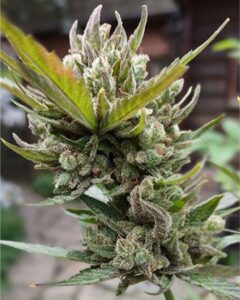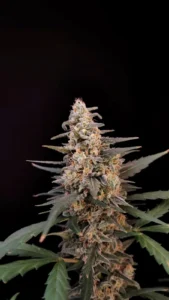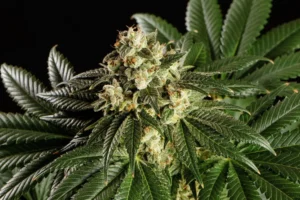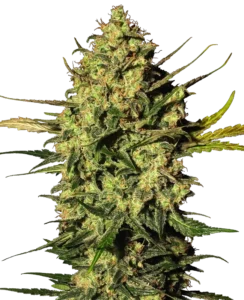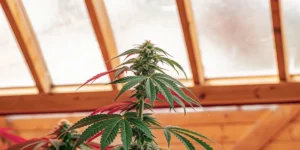


Blue Sunset Sherbert is an indica-dominant feminized photoperiod strain from Barney’s Farm created from Sunset Sherbet and Purple Punch genetics. The current seed line is classified as 65% Indica and 35% Sativa, reaches 28% THC and flowers in approximately 59–63 days.
Current breeder data lists plants at approximately 100–120 cm indoors and 150–200 cm outdoors. Indoor production is rated at 550–650 g/m², while outdoor plants can produce up to 1,000 g each and are generally ready for harvest during the first or second week of October.
Recommended Strains

Royal AK Auto

|
THC | 14% - 15% (Medium) |

|
Lineage | AK 47 x Ruderalis |

|
Type | Autoflowering |

|
Height | 2.79 ft | 0.85 m |

|
Yield | Low |

|
Yield Indoor | 0.9 - 1.15 oz/ft² | 275 - 350 g/m² |

|
Yield Outdoor | 3.88 - 5.64 oz/plant | 110 - 160 g/plant |

|
Life Cycle | 6 - 8 weeks |

|
Phenotype | 40% Indica / 35% Sativa / 25% Ruderalis |

|
Effects | Giggly, Uplifted |

|
Flavors | Earthy, Pepper, Sour |
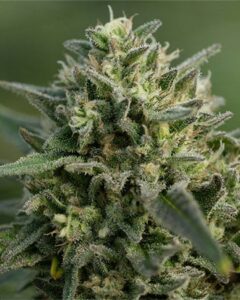
Girl Scout Cookies Fem
|
|
THC | 27% - 28% (High) |
|
|
Lineage | OG Kush x Durban Poison |
|
|
Type | Feminized |
|
|
Height | 3.28 ft | 1 m |
|
|
Yield | Low |
|
|
Yield Indoor | 0.98 oz/ft² | 300 g/m² |
|
|
Yield Outdoor | 10.58 oz/plant | 300 g/plant |
|
|
Flowering Time | 9 - 10 weeks |
|
|
Phenotype | 60% Indica / 40% Sativa |
|
|
Effects | Creative, Euphoric, Happy |
|
|
Flavors | Earthy, Herbal, Lemon |
| Blue Sunset Sherbert Grow Info | Current specification |
|---|---|
| Breeder | Barney’s Farm |
| Genetics | Sunset Sherbet × Purple Punch |
| Seed type | Feminized photoperiod |
| Indica / Sativa | 65% Indica / 35% Sativa |
| THC | 28% |
| Flowering time | 59–63 days |
| Indoor height | 100–120 cm |
| Outdoor height | 150–200 cm |
| Indoor yield | 550–650 g/m² |
| Outdoor yield | Up to 1,000 g/plant |
| Outdoor harvest | October, 1st–2nd week |
| Taste | Citrus, Sweet Candy |
| Aroma | Sweet Berry, Citrus Zest, Sweet Candy |
| Reported effects | Calming, Creative, Euphoric, Tranquilising |
Blue Sunset Sherbert Genetics
Blue Sunset Sherbert combines Sunset Sherbet with Purple Punch, creating a strongly indica-dominant photoperiod hybrid.
Older descriptions sometimes associate Blue Sunset Sherbert with Blueberry genetics, but that is not the current parentage published for the Barney’s Farm seed line. Blueberry should therefore not be presented as one of the parents in a current grow guide.
The Purple Punch side contributes to the strain’s dense flowering structure and colorful appearance, while the Sunset Sherbet background is reflected in its sweet, citrus-forward sensory profile.
Growers interested in other genetics from the same breeder can explore the wider Barney’s Farm seed collection.
Blue Sunset Sherbert vs Blue Sunset Sherbet: Which Spelling Is Correct?
The official cultivar name is Blue Sunset Sherbert, with a second “r” in Sherbert.
The confusion is understandable because one of its documented parents is Sunset Sherbet, which is spelled without that second “r.” As a result, searches for Blue Sunset Sherbet often refer to the same Blue Sunset Sherbert cultivar.
For product names, titles and technical grow data, use Blue Sunset Sherbert as the canonical spelling. The alternative Blue Sunset Sherbet spelling can be mentioned naturally when explaining the name, but it should not replace the official cultivar name.
Is Blue Sunset Sherbert Indica or Sativa?
Blue Sunset Sherbert is 65% Indica and 35% Sativa, making it clearly indica dominant.
Its structure combines manageable indoor height with extensive lateral branching, allowing the plant to build a substantial productive canopy without becoming exceptionally tall indoors.
The genetic ratio does not mean that every phenotype or subjective experience will be identical. Barney’s Farm describes the effects as calming, creative, euphoric and tranquilising, illustrating how a strongly Indica-leaning cultivar can still include noticeable cerebral characteristics.
How Much THC Does Blue Sunset Sherbert Have?
Barney’s Farm currently lists Blue Sunset Sherbert at 28% THC.
Some Growlantis catalog data still shows a 28–29% range, but 28% is the current breeder specification and is the most appropriate figure for the present seed line.
A published THC percentage describes genetic potency potential rather than guaranteeing that every harvested flower will test at exactly 28%. Phenotype, lighting, plant health, harvest timing and post-harvest handling can all influence the cannabinoid concentration measured in an individual crop.
Blue Sunset Sherbert Flavor, Aroma and Terpenes
Blue Sunset Sherbert has a sweet, citrus-led sensory profile rather than the Blueberry-centered profile found in some older descriptions.
Barney’s Farm currently lists citrus and sweet candy as the main tastes, while the aroma combines sweet berry, citrus zest and sweet candy.
The breeder also describes limonene, humulene and terpinolene within the strain’s terpene profile. These compounds can be mentioned as part of the documented aromatic character, but they should not be used to make guaranteed medical claims or to predict one exact effect from each terpene.
The result is a sweet and fruity profile with bright citrus character and softer berry notes.
Blue Sunset Sherbert Flowering Time
Blue Sunset Sherbert has a current breeder-listed flowering period of 59–63 days.
This figure begins after the indoor plant is transitioned into flowering. It is not the complete amount of time from germination to harvest because Blue Sunset Sherbert is photoperiodic and the grower controls the length of vegetative growth.
Indoor flowering is normally initiated by moving the plant to approximately 12 hours of light and 12 hours of uninterrupted darkness. From that transition onward, the 59–63 day breeder range becomes the main timing reference.
For more context on what changes after the light-cycle transition, see the cannabis flowering stage guide.

Blue Sunset Sherbert Height and Plant Structure
Current breeder data lists Blue Sunset Sherbert at approximately 100–120 cm indoors and 150–200 cm outdoors.
These separate figures are more useful than older listings that describe the cultivar with one universal height such as 1.75 meters.
The plant develops substantial lateral branching, which allows it to create a wide productive structure without requiring extreme indoor height. These side branches can also carry relatively heavy flowering sites later in the cycle.
Indoor growers can influence final size through vegetative duration, container volume and training, while outdoor plants have more space and time to develop toward the upper end of the breeder range.
Growing Blue Sunset Sherbert Indoors
Blue Sunset Sherbert is currently listed at approximately 550–650 g/m² indoors.
Its 100–120 cm indoor height makes it manageable in many controlled grow spaces, but the lateral branching means growers should account for canopy width as well as vertical clearance.
There is no fixed vegetative duration required before flowering. Indoor growers can maintain the plant in vegetative growth until its root system and branch structure fit the available flowering area.
Once the canopy reaches the desired size, moving to a flowering light schedule begins the 59–63 day bloom period.
Focus on healthy canopy development and even light access rather than trying to reach an arbitrary number of vegetative weeks.
Growing Blue Sunset Sherbert Outdoors
Outdoors, Blue Sunset Sherbert reaches approximately 150–200 cm and can produce up to 1,000 g per plant under favorable conditions.
Barney’s Farm lists the outdoor harvest window as the first to second week of October in the Northern Hemisphere.
Outdoor plants need enough spacing for their lateral branches to expand without becoming heavily crowded. Strong sunlight, healthy root development and a sufficiently long growing season all influence how closely a plant approaches the breeder’s upper production specification.
The 1,000 g figure represents genetic yield potential rather than a harvest that every plant should be expected to achieve.
Blue Sunset Sherbert Yield
Current specifications list Blue Sunset Sherbert at 550–650 g/m² indoors and up to 1,000 g per plant outdoors.
Indoor yield is expressed by canopy area because plant count and vegetative duration can vary considerably between grow setups. A smaller number of larger plants and a larger number of smaller plants can occupy the same illuminated area.
Outdoor production is expressed per plant because each plant has considerably greater access to root and canopy space.
Both figures should be treated as breeder-listed production potential. Light, roots, plant health, environment, vegetative duration and canopy management can all influence final yield.
How to Germinate Blue Sunset Sherbert Seeds
Barney’s Farm recommends the paper-towel method for germinating Blue Sunset Sherbert.
Seeds can be placed between damp paper towels and kept in a warm, dark environment while moisture remains consistent. The breeder currently gives a germination temperature range of approximately 70–90°F (21–32°C).
Once the taproot emerges, the sprouted seed can be transferred carefully into a suitable growing medium with the root facing downward. Handle the new root as little as possible during this stage.
For more detail on managing temperature and moisture during germination, see the cannabis seed germination temperature and humidity guide.
Vegetative Growth
Blue Sunset Sherbert does not have a fixed eight- or nine-week vegetative stage.
As a photoperiod plant, it remains in vegetative growth until the indoor grower changes the light schedule. This allows the plant to be adapted to the available space rather than following an arbitrary calendar.
Use vegetation to establish healthy roots and a productive branch structure. The cultivar naturally develops numerous lateral branches, which can later become substantial flowering sites.
Growers with limited vertical or horizontal space can initiate flowering earlier, while larger rooms can accommodate additional development.
The decision should be based on actual plant size and canopy coverage rather than reaching a particular week.
Training Blue Sunset Sherbert
Blue Sunset Sherbert’s strong lateral branching makes it suitable for canopy management during vegetative growth.
Gentle low-stress training can move side branches outward and create a broader, more evenly illuminated canopy. Topping can also be considered while the plant is healthy and still has enough vegetative recovery time before flowering.
The goal is to distribute growth across the available area rather than allow several branches to overlap heavily.
Training should not be presented as a guarantee of a specific yield or THC percentage. Plant health, light coverage, root development and the quality of the flowering environment remain important factors regardless of the technique used.
Flowering Development
After the indoor light-cycle transition, Blue Sunset Sherbert enters a flowering stage lasting approximately 59–63 days.
The plant can continue adding some structural growth during the early transition while flowering sites establish along the side branches.
As bloom progresses, flowers become increasingly dense and resinous and the sweet candy, berry and citrus-zest aroma becomes more pronounced. The cultivar is also known for developing strong coloration as maturity approaches.
Good spacing becomes increasingly important as the flowers gain mass. Overlapping branches and dense floral growth can create localized areas where moisture stays higher than in the surrounding grow space.
Use the breeder timeline as a planning reference while assessing the maturity of the individual plant.
Feeding Blue Sunset Sherbert
Blue Sunset Sherbert does not require one universal strain-specific NPK formula.
Nutrition should be adapted to the growing medium, fertilizer system, water quality, root volume, plant size and visible response.
There is no need to prescribe a fixed 3-1-2 vegetative formula or automatically switch to a 1-3-4 ratio during flowering. Likewise, increasing phosphorus and potassium should not be presented as a guaranteed method for increasing potency, resin or terpene production.
Follow the nutrient program designed for the chosen medium and make gradual adjustments when the plant itself provides evidence that they are needed.

Watering Blue Sunset Sherbert
Water requirements change substantially as Blue Sunset Sherbert develops.
A seedling with a small root system requires far less water than a mature flowering plant supporting multiple heavy branches. Avoid watering according to one fixed calendar throughout the grow.
In containers, substrate moisture and pot weight can provide useful information about actual demand. Ensure that excess water can drain rather than leaving the root zone permanently saturated.
Outdoor plants may require considerably more irrigation during warm periods, but watering should still respond to soil conditions, rainfall, plant size and actual root-zone moisture rather than one universal schedule.
Airflow and Dense Flower Management
Blue Sunset Sherbert can develop numerous side branches carrying dense flowering sites, making internal canopy airflow increasingly important later in bloom.
Air should move gently above, through and below the canopy while ventilation removes excess heat and humidity from the grow space.
A room-level humidity reading does not always describe the conditions inside a dense flower or between overlapping branches. Creating space within the canopy can help reduce those stagnant microclimates.
Common Blue Sunset Sherbert Growing Problems
One common planning mistake is assuming that flowering begins automatically after eight or nine weeks of vegetative growth. Blue Sunset Sherbert is photoperiodic, so indoor flowering begins when the grower changes the light schedule.
Overwatering and excessive nutrient concentration are broader cultivation problems rather than documented strain-specific weaknesses. Diagnose them from the root zone and the plant’s actual symptoms rather than following an aggressive feeding calendar.
Canopy congestion is another practical concern because of the plant’s extensive lateral branching. Good spacing and sensible training can improve both light access and airflow.
Finally, avoid treating Blue Sunset Sherbert as universally pest- or mold-resistant. Current breeder specifications do not establish such a guarantee.
When to Harvest Blue Sunset Sherbert
Indoor Blue Sunset Sherbert generally reaches its expected harvest window after approximately 59–63 days of flowering.
Outdoors, the current breeder reference is the first to second week of October.
These timings should guide planning rather than act as automatic cutting dates. As the expected window approaches, inspect actual flower development and trichome maturity.
There is no need to require one fixed percentage of amber trichomes for every plant or to promise a specific potency or effect based entirely on that ratio.
After harvest, drying and curing should be treated as separate post-harvest stages rather than extra weeks added to the flowering period.
Blue Sunset Sherbert Effects
Barney’s Farm currently describes Blue Sunset Sherbert as calming, creative, euphoric and tranquilising.
Those reported characteristics combine its strong Indica dominance with noticeable cerebral qualities, which helps explain why older descriptions sometimes incorrectly call it a balanced hybrid.
The cultivar is currently listed at 28% THC, indicating high potency potential, but cannabinoid percentage alone cannot predict exactly how every individual will respond.
Dose, tolerance and the complete chemistry of a particular harvest can all influence the experience. These descriptions should remain subjective characteristics rather than medical claims.
Blue Sunset Sherbert FAQs
How long does Blue Sunset Sherbert take to flower?
Blue Sunset Sherbert has a current breeder-listed flowering period of 59–63 days after the indoor light schedule is changed to flowering. This is not the full seed-to-harvest timeline because the plant is photoperiodic. Growers control how long vegetative growth lasts before switching to approximately 12 hours of light and 12 hours of darkness.
Is Blue Sunset Sherbert Indica or Sativa?
Blue Sunset Sherbert is an indica-dominant hybrid classified as 65% Indica and 35% Sativa. Its documented genetics combine Sunset Sherbet with Purple Punch. The ratio describes the seed line itself, while final plant structure and reported effects can still vary somewhat with phenotype, environment, dose and individual response.
How much THC does Blue Sunset Sherbert have?
Barney’s Farm currently lists Blue Sunset Sherbert at 28% THC. Growlantis category data still shows a 28–29% range, so the product listing should be aligned with the current breeder specification. The published percentage represents genetic potential rather than a guarantee that every harvested flower will test at exactly 28%.
How much does Blue Sunset Sherbert yield?
Current breeder data lists Blue Sunset Sherbert at approximately 550–650 g/m² indoors and up to 1,000 g per plant outdoors. These figures describe production potential under favorable conditions rather than guaranteed harvests. Light, root space, vegetative duration, climate, plant health and canopy management can all influence final yield.
How tall does Blue Sunset Sherbert grow?
Blue Sunset Sherbert currently reaches approximately 100–120 cm indoors and 150–200 cm outdoors according to the breeder’s structured data. Indoor growers can also influence final size through vegetative duration and training. These environment-specific figures are more useful than older Growlantis listings that describe the strain with one universal 1.75 m height.
Is it Blue Sunset Sherbert or Blue Sunset Sherbet?
The official cultivar name is Blue Sunset Sherbert, with a second “r” in Sherbert. One documented parent is Sunset Sherbet, without that second “r,” which explains why both spellings appear in search data. Use Blue Sunset Sherbert in titles and headings while mentioning the common Blue Sunset Sherbet variant naturally once in the article.