
Breeding weed means deliberately crossing selected cannabis plants and evaluating their offspring to combine, preserve or stabilize desirable traits. A breeder chooses parents, produces a first filial generation, grows enough offspring to observe variation, selects the best individuals and continues crossing or backcrossing them over multiple generations. Making seeds is easy; producing predictable genetics takes much more selection and testing.
What Does Breeding Weed Mean?
Cannabis breeding is the deliberate selection and mating of plants to influence the traits found in future generations.
Recommended Strains
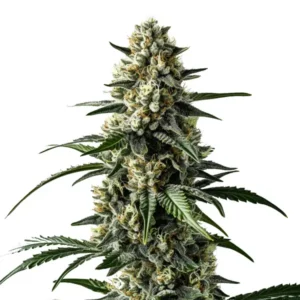
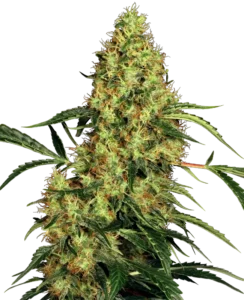
Mango

|
THC | 20% - 22% (Medium) |

|
Lineage | Jack Herer x Big Skunk |

|
Type | Feminized |

|
Height | 9.84 ft | 3 m |

|
Yield | High |

|
Yield Indoor | 1.31 - 1.64 oz/ft² | 400 - 500 g/m² |

|
Yield Outdoor | 21.16 - 24.69 oz/plant | 600 - 700 g/plant |

|
Flowering Time | 8 - 10 weeks |

|
Phenotype | 70% Indica / 30% Sativa |

|
Medical | Anxiety, Depression, Insomnia |

|
Effects | Calming, Relaxed, Sleepy |

|
Flavors | Mango, Sweet, Tropical |
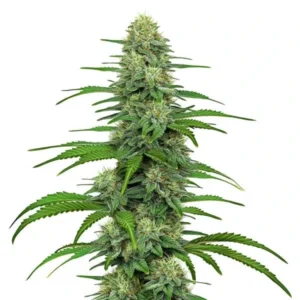
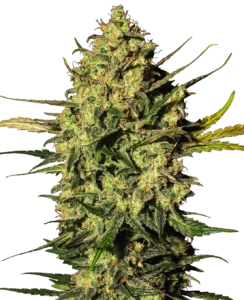
GG4
|
|
THC | 27% (High) |
|
|
Lineage | Chem Sis x Sour Dubb x Diesel Chocolate |
|
|
Type | Feminized |
|
|
Height | 6.56 ft | 2 m |
|
|
Yield | High |
|
|
Yield Indoor | 1.64 - 1.97 oz/ft² | 500 - 600 g/m² |
|
|
Yield Outdoor | 24.69 - 28.22 oz/plant | 700 - 800 g/plant |
|
|
Flowering Time | 8 - 10 weeks |
|
|
Phenotype | 40% Indica / 60% Sativa |
|
|
Medical | Anxiety, Depression, Pain |
|
|
Effects | Happy, Relaxed, Talkative |
|
|
Flavors | Fruity, Pine, Spicy |
Those traits might include:
- plant structure;
- flowering behavior;
- cannabinoid profile;
- aroma and terpene chemistry;
- resistance or tolerance to disease;
- yield;
- maturity timing;
- or adaptation to a particular environment.
Cannabis is typically dioecious, meaning male and female flowers are normally produced on separate plants, although sex expression is more complex and can also be influenced by genotype, development and environmental conditions.
The important distinction is that breeding creates new genetic combinations.
Growing a seed population and choosing your favorite individual is selection or “pheno hunting.” It becomes breeding when selected individuals are used as parents for another generation.
Breeding vs Pheno Hunting
These terms are related but not interchangeable.
Pheno hunting means growing genetically related plants and selecting individuals with desirable observable traits.
Breeding means using selected plants to produce another generation.
A breeder often does both.
For example, a breeder may grow many seedlings from the same cross, identify plants with the desired aroma, structure and maturity, and then use selected individuals as parents for the next generation.
The phenotype you observe is not simply “the genetics.”
Phenotype is the result of genotype interacting with the environment, so comparing candidate parents under reasonably similar conditions makes selection more meaningful.
The current article correctly recognizes the importance of phenotype comparison and trait scoring, but I would make that genotype-versus-environment distinction explicit.
How Does Cannabis Breeding Work?
At its simplest, the process follows this logic:
- Define the breeding objective.
- Select parent plants.
- Cross the selected parents.
- Grow the offspring.
- Evaluate variation.
- Select individuals closest to the target.
- Breed selected offspring again.
- Repeat until the population meets the desired level of consistency.
The first cross is only the beginning.
One pollination can produce seeds, but those seeds do not automatically constitute a stable new strain.
Serious breeding requires repeated evaluation across populations and generations.
Step 1: Define the Trait You Want
“Better weed” is not a useful breeding goal.
A breeder needs specific selection criteria.
For example:
- earlier flowering;
- a particular cannabinoid ratio;
- a defined aroma profile;
- shorter plant structure;
- reduced susceptibility to a known pathogen;
- or greater uniformity.
Selection becomes much less meaningful when the goal changes every generation.
The current article lists yield, aroma and pest resistance as examples, which is directionally correct.
What I would avoid is assuming that the visually “best” plant automatically has the best heritable genetics.
A phenotype can perform exceptionally well partly because of environmental conditions.
Step 2: Choose Parent Plants
Parent selection is one of the most important parts of a breeding program.
A good parent is not simply the plant with the largest flowers or strongest aroma.
The breeder should consider:
- whether the desired trait is repeatable;
- whether the plant is vigorous and healthy;
- whether its chemistry matches the breeding objective;
- how it performs across environments;
- and what its relatives or offspring reveal about its breeding value.
This becomes particularly important with cannabis because commercial strain names do not reliably certify genetic identity.
A genetic study found that in 6 of 17 same-name comparisons, cannabis samples were more genetically similar to differently named samples than to other samples sharing the same name. The researchers concluded that genetic identity could not reliably be inferred from the commercial strain name or reported ancestry alone.
So “cross Strain A with Strain B” is less informative than knowing the actual parent material being used.
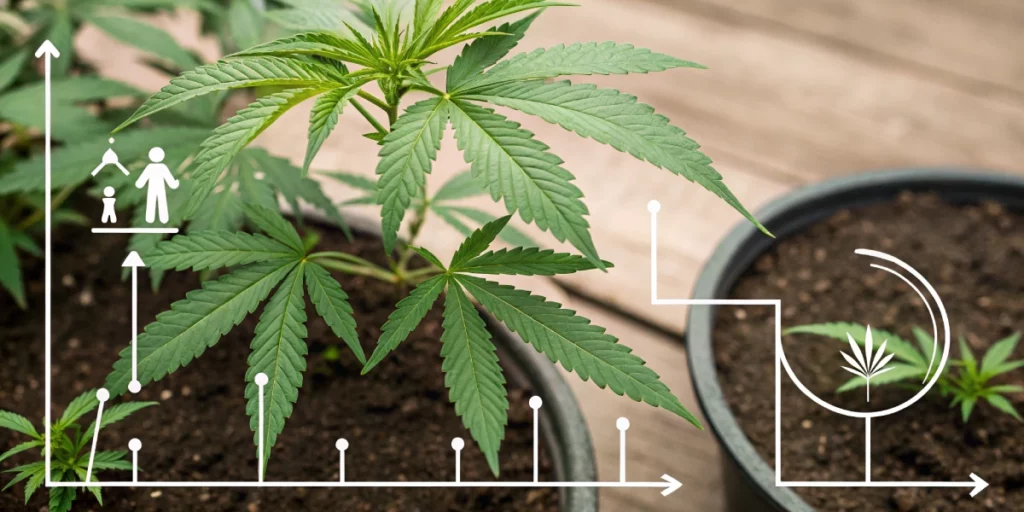
What Is an F1 Cannabis Cross?
F1 means first filial generation.
It is the first generation produced from two selected parental lines.
If Parent A is crossed with Parent B:
A × B → F1
But there is an important misconception here.
An F1 is not automatically uniform.
Classic hybrid uniformity depends heavily on the genetic consistency of the parental lines. Crossing two highly heterozygous cannabis plants can produce substantial variation even in the F1.
That matters because modern commercial cannabis has undergone extensive hybridization, and cultivar labels frequently contain considerable chemical and genetic variability.
Therefore, F1 describes generation, not quality or stability.
What Is an F2 Cannabis Generation?
An F2 is produced by breeding individuals from the F1 generation.
A simplified model is:
A × B → F1
then
F1 × F1 → F2
The F2 generation is particularly useful to breeders because genetic recombination and segregation can reveal combinations of traits that were less obvious in the F1.
This can create substantial phenotypic variation.
A breeder can then search through the F2 population for individuals that combine the target characteristics.
This is why larger breeding populations provide much more information than making decisions from only one or two seedlings.
What Does F3, F4 and F5 Mean?
These labels simply describe subsequent filial generations.
Selected F2 individuals can be used to create an F3, selected F3 plants can produce an F4, and so on.
Repeated selection can gradually increase consistency for chosen traits, but the generation number itself does not prove that a line is stable.
An F5 selected poorly may be less useful than an earlier generation managed with a clear breeding objective and careful records.
So I would avoid rules such as:
“F5 means stable.”
A better question is:
How consistently does the target trait appear across the tested population?
That requires growing and evaluating offspring.
What Is Backcrossing in Cannabis?
A backcross, often written BX, means crossing offspring back to one of its parents or to genetically similar recurrent parental material.
For example:
Parent A × Parent B → F1
then:
F1 × Parent A → BX1
The objective is usually to recover more characteristics associated with the recurrent parent while retaining a desired contribution from the other side of the cross.
Backcrossing is especially useful when a breeder wants to preserve or reintroduce a particular trait from an important parent.
However, saying that backcrossing automatically “locks in” desirable genetics is too simplistic.
Unwanted alleles linked to desired traits can also be carried forward, and selection still matters at each generation.
What Is Inbreeding?
Inbreeding means mating genetically related individuals.
Sibling crosses and repeated selfing are examples.
The purpose is often to increase homozygosity so that certain characteristics are reproduced more consistently in subsequent generations.
But increased homozygosity is not automatically beneficial.
It can also expose deleterious recessive alleles and reduce vigor in some populations.
A recent review of feminized cannabis seed production specifically recommends evaluating progeny against the parental material for growth and reproductive performance because repeated inbreeding can have negative consequences.
So “more inbred = more stable = better” is not a valid universal rule.
What Does Stabilizing a Cannabis Strain Mean?
Stabilization means making specific target traits more predictable across offspring.
It does not mean producing genetically identical plants from seed.
Each sexual generation reshuffles genetic material.
A stable seed line therefore means that a useful proportion of offspring consistently fall within a defined target range for traits the breeder cares about.
For example, a breeder might evaluate whether plants consistently show:
- similar maturation timing;
- similar stature;
- similar cannabinoid chemistry;
- a recurring terpene profile;
- or resistance to a particular disease.
The current article describes stabilization as repeatedly breeding until plants “show the same characteristics.”
I would soften that to predictable trait expression within a defined population, rather than identical plants.
What Is Selfing or an S1?
Selfing means producing offspring using gametes derived from the same selected genotype.
The resulting first selfed generation is commonly called S1.
In cannabis breeding, genetically female plants can be induced to form staminate flowers and pollen, allowing pollen from female genetic material to fertilize female flowers.
Scientific cannabis breeding research confirms that ethylene inhibition can induce male flowers on genetically female plants and is widely used for feminized seed production.
S1 does not mean “clone in seed form.”
Recombination still occurs.
S1 offspring can resemble the parent strongly while also revealing recessive variation that was hidden in the original heterozygous plant.
Are Feminized Seeds Genetically Different From Regular Seeds?
Feminized seed production changes the sex chromosomes contributed to the cross, but it does not eliminate genetic variation.
Traditional regular-seed breeding can involve male and female parents.
Feminized seed production instead uses pollen generated from genetically female material, so the progeny generally lack the Y chromosome associated with male plants.
This technique can be used for:
- selfing;
- female × female crosses;
- preservation projects;
- or breeding programs where predominantly female progeny are desired.
But feminized does not mean:
- genetically identical;
- stable;
- higher quality;
- or guaranteed free of sex-expression problems.
Those are separate traits.
Can You Breed Cannabis Without a Male Plant?
Yes.
Traditional breeding uses male pollen, but modern feminized breeding can use pollen produced by genetically female plants.
Scientific studies have repeatedly demonstrated induced male-flower formation on female cannabis plants for seed production.
That means a breeder can make a female × female cross or self a selected female genotype.
However, this should not be confused with cloning.
Cloning reproduces an individual genotype vegetatively.
Sexual breeding — including selfing — creates new seed-derived individuals.
Why Population Size Matters
Breeding from only a few plants gives the breeder a very narrow view of the genetic variation inside a cross.
Imagine that an F2 population contains a rare combination of two desired traits.
If only five seedlings are grown, that combination may never appear.
With a larger population, there is a better chance of observing the range of recombination present in the cross.
Population size becomes especially important when:
- selecting multiple traits simultaneously;
- working with recessive traits;
- identifying disease resistance;
- or trying to determine whether a phenotype is genuinely repeatable.
There is no universal number of plants required because that depends on the genetic architecture of the trait and the breeder’s objective.
I would therefore avoid publishing arbitrary rules like “you need exactly 20 plants” or “50 plants guarantees selection.”
Genotype vs Phenotype in Cannabis Breeding
A genotype is the inherited genetic information carried by the plant.
A phenotype is the observable result produced by that genotype interacting with its environment.
For example, two genetically similar plants grown under different light, temperature, root-zone or disease conditions may differ in:
- height;
- flowering time;
- color;
- yield;
- and chemical composition.
That is why breeding trials should try to compare candidates under reasonably consistent conditions.
The current article already recognizes environmental variability as a source of confusion, and that section is worth keeping.
I would simply connect it more explicitly to the concept of heritability.
A breeder needs to distinguish:
“This plant looked good.”
from:
“This plant reliably passes the trait to its offspring.”
Those are not the same thing.
How Should Breeders Evaluate Cannabis Offspring?
Visual selection is useful, but it cannot measure every important trait.
Depending on the breeding objective, evaluation may include:
- plant structure;
- developmental timing;
- disease response;
- yield;
- cannabinoid analysis;
- terpene analysis;
- and molecular markers.
The existing article lists yield, potency and flavor, but I would replace “simple tests” with a clearer distinction between observational and laboratory traits.
You can estimate plant structure visually.
You cannot reliably determine exact THC percentage or terpene concentration by appearance or smell alone.
Why Cannabis Strain Names Are a Problem for Breeders
Cannabis breeding has another complication: commercial names are poorly standardized.
Large-scale chemical analysis of nearly 90,000 commercial cannabis samples found substantial inconsistency between common market labels and actual chemistry. Products sharing the same strain name could vary considerably between producers.
Genetic studies have reached similar conclusions.
Cannabis samples carrying the same name are not always more genetically similar to one another than samples carrying different names.
For breeding purposes, this means provenance matters.
Knowing that a parent is labeled “Gelato,” “GG4” or “Mango” is less useful than knowing:
- where the parent came from;
- whether it is seed-derived or clonally maintained;
- what generation it belongs to;
- whether its chemistry has been measured;
- and what its offspring actually do.
What Is a True-Breeding Cannabis Line?
“True breeding” is best treated as a relative rather than absolute term.
A line breeds true for a trait when offspring repeatedly express that target trait at a sufficiently high and predictable frequency.
A plant may breed relatively true for one characteristic while still showing substantial variation in another.
For example, a population might be highly consistent for flower color but variable in:
- height;
- aroma;
- yield;
- or cannabinoid content.
So stability should always be discussed trait by trait.
Does Crossing Two Good Strains Make a Better Strain?
No.
Combining two desirable parents does not guarantee superior offspring.
Each parent carries many alleles, including traits that may not be obvious from its own phenotype.
Recombination can produce:
- excellent offspring;
- average offspring;
- poor combinations;
- and unexpected traits.
The role of breeding is therefore not merely crossing two famous cultivars.
The real work begins after the cross, when the breeder evaluates what the offspring actually inherited.
Common Cannabis Breeding Mistakes
Choosing Parents Only by Strain Name
A famous name does not prove genetic identity or breeding value.
Selecting Only by Appearance
Visual phenotype cannot reveal cannabinoid chemistry, hidden alleles or how well a trait will transmit to offspring.
Calling an F1 “Stable”
F1 is a generation label, not a certificate of uniformity.
Assuming Backcrossing Fixes Everything
A backcross increases genetic contribution from a recurrent parent but does not remove the need for selection.
Using Too Few Offspring
Tiny populations make it easy to miss useful recombinants and difficult to judge trait frequencies.
Changing Selection Goals
If the target changes every generation, the breeder is not really selecting toward a defined outcome.
Keeping Poor Records
Without parent IDs, generation labels and phenotype notes, reproducing a promising cross becomes difficult.
How Long Does Cannabis Breeding Take?
There is no fixed number of generations or years.
Producing seeds from one cross is relatively quick.
Developing a population that repeatedly expresses several desired characteristics can require many generations of:
- crossing;
- evaluation;
- selection;
- and retesting.
The more complex the goal, the more extensive the testing typically becomes.
Cannabis researchers studying seed feminization likewise emphasize evaluating progeny for germination, plant performance and trait retention rather than judging success merely from successful seed production.
So the useful distinction is:
Making cannabis seeds can be straightforward. Developing reliable genetics is a breeding program.
Breeding Weed: Bottom Line
Breeding weed is the deliberate process of selecting cannabis parents, creating offspring and repeatedly evaluating which traits are inherited.
A basic cross produces an F1 generation. Crossing F1 individuals can create an F2 population with greater segregation. Backcrossing moves offspring back toward a selected parent, while selfing and related-parent crosses can increase homozygosity and expose hidden genetic variation.
None of those labels automatically guarantees quality or stability.
The real measure of a breeding program is whether the target traits repeatedly appear in a sufficiently large and tested population.
And because commercial cannabis names do not consistently represent identical genetics or chemistry, breeders should prioritize documented parent material, phenotype data, laboratory testing and offspring performance over strain-name reputation.
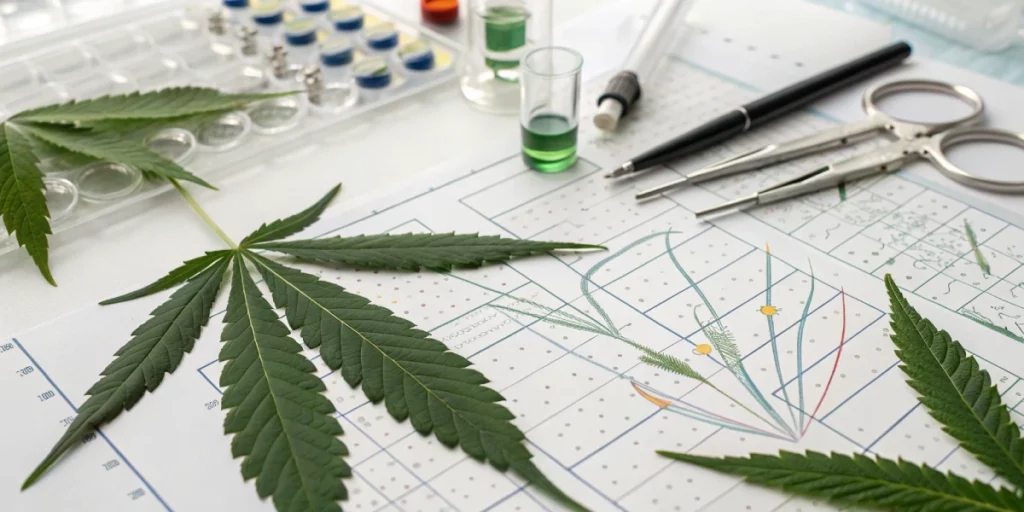
FAQs About Breeding Weed
What is breeding weed?
Breeding weed means deliberately crossing selected cannabis plants and evaluating their offspring to preserve, combine or stabilize desired characteristics. The process usually involves parent selection, controlled crosses, growing offspring, phenotype evaluation and further selection over multiple generations. Producing seeds is only the first step; determining whether traits are reliably inherited requires progeny testing.
What does F1 mean in weed breeding?
F1 means first filial generation: the offspring produced from the initial parental cross. An F1 is not automatically genetically uniform or stable. Its consistency depends heavily on the genetic composition of the parents. Highly heterozygous cannabis parents can produce substantial variation even in their first-generation offspring.
What is an F2 cannabis generation?
An F2 is normally produced by breeding selected F1 individuals. Genetic recombination and segregation can reveal much greater trait variation in this generation, making F2 populations particularly useful for selection. Breeders search through that variation for individuals combining the traits they want to advance into later generations.
What is backcrossing cannabis?
Backcrossing means mating offspring back to one of the original parents or comparable recurrent parental material. It is used to increase the genetic contribution of that parent while attempting to retain another desired trait. Backcrossing does not automatically make a line stable; breeders still need to select and test the resulting offspring.
What does S1 mean in cannabis breeding?
S1 means the first selfed generation. It is produced when genetic material from the same selected plant contributes both sides of the cross, commonly through induced pollen production from genetically female cannabis. S1 seeds are not clones: sexual recombination still occurs, so offspring can expose genetic variation hidden in the original parent.
How many generations does it take to stabilize cannabis genetics?
There is no universal generation number. Stability depends on the original parents, population size, traits being selected and breeding method. A line may become consistent for one trait before another. Rather than declaring every F4, F5 or F6 “stable,” breeders should evaluate how reliably the target phenotype appears across tested offspring.