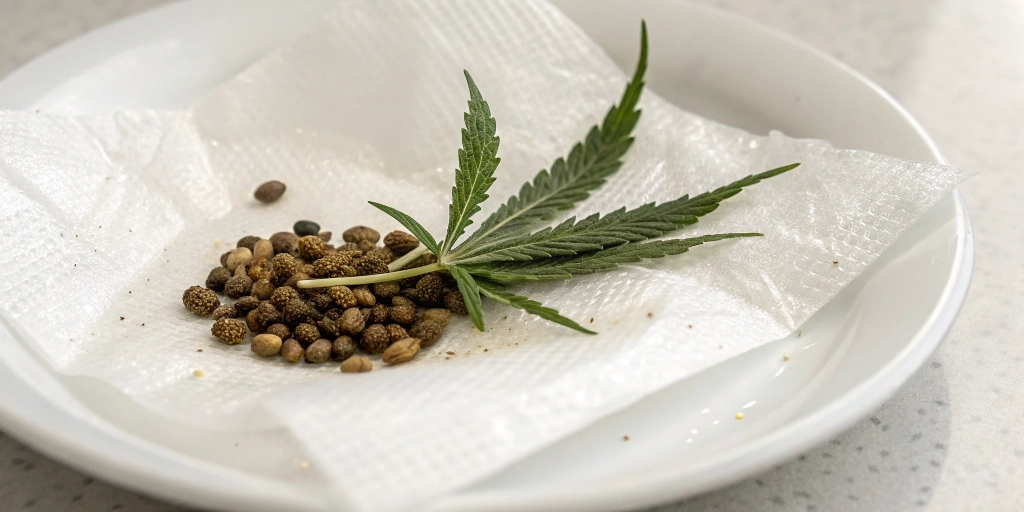

To sprout a cannabis seed, keep it warm, consistently moist and well aerated until the seed coat opens and the white radicle emerges. The simplest method is direct sowing into a light, moist medium; a damp paper towel also works. Water soaking is optional, not required, and the seed should be transferred once the radicle appears.
What Does It Mean When a Cannabis Seed Sprouts?
A cannabis seed has germinated once the seed coat opens and the first white root, called the radicle, begins to emerge.
Recommended Strains
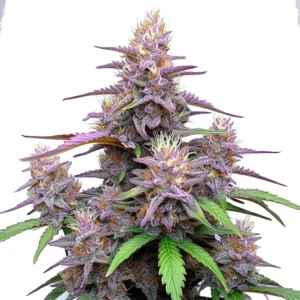
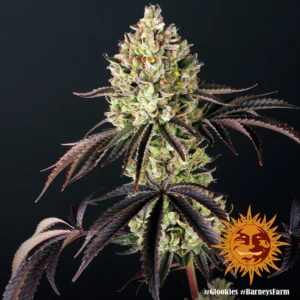
Gorilla Purple Auto

|
THC | 20% - 24% (High) |

|
Lineage | GG4 x Purple Punch |

|
Type | Autoflowering |

|
Height | 4.92 ft | 1.5 m |

|
Yield | High |

|
Yield Indoor | 1.8 - 1.97 oz/ft² | 550 - 600 g/m² |

|
Yield Outdoor | 4.23 - 7.05 oz/plant | 120 - 200 g/plant |

|
Life Cycle | 9 - 11 weeks |

|
Phenotype | 50% Indica / 50% Sativa |

|
Medical | Arthritis, Insomnia, Pain |

|
Effects | Creative, Euphoric, Relaxed |

|
Flavors | Citrus, Earthy, Sweet |
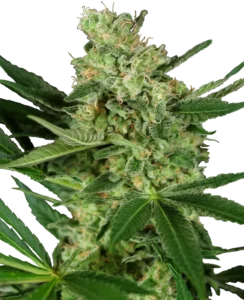
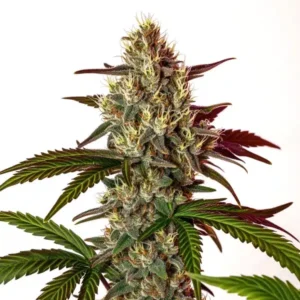
Pumpkin Spice Strain
|
|
THC | 21% - 23% (Medium) |
|
|
Lineage | Sour Apple x Animal Cookies |
|
|
Type | Feminized |
|
|
Height | 5.74 ft | 1.75 m |
|
|
Yield | High |
|
|
Yield Indoor | 1.31 - 1.8 oz/ft² | 400 - 550 g/m² |
|
|
Flowering Time | 9 - 10 weeks |
|
|
Phenotype | 50% Indica / 50% Sativa |
|
|
Effects | Creative, Uplifted, Happy |
|
|
Flavors | Apple, Earthy, Citrus, Pine |
That is the key event to watch for.
You do not need to wait for a long taproot, green leaves or the seed shell to fall away before calling the seed germinated. Cannabis germination research similarly records germination at radicle emergence.
After that point, the root begins growing downward while the emerging shoot eventually pushes upward and develops cotyledons.
What Is the Easiest Way to Sprout a Cannabis Seed?
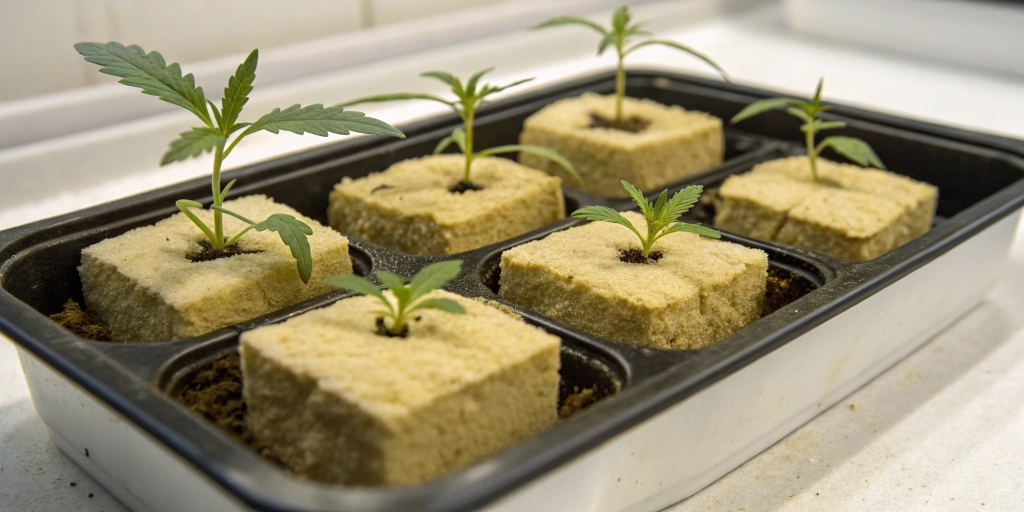
For most growers, direct sowing into the growing medium is the simplest method.
A 2023 cannabis study compared 13 germination approaches, including soaking in water for 18 or 24 hours, hydrogen peroxide, bleach, potassium nitrate, scarification and direct sowing.
None produced a statistically significant improvement in final germination rate. Direct sowing nevertheless produced the numerically highest and most uniform germination in that experiment, so the researchers used it for the rest of their cannabis trials.
That is important because many cannabis guides present soaking, scarifying or chemically treating seeds as necessary steps.
They are not.
Method 1: Sprout a Cannabis Seed Directly in Soil or Growing Medium
Start with a small container or final growing container filled with a light, well-aerated medium.
Moisten the medium before planting so it is evenly damp but not waterlogged.
Make a shallow hole, place the cannabis seed inside and cover it lightly. The current article’s recommendation of roughly 1 cm deep is a reasonable practical starting point, but there is no need to treat that depth as an exact biological requirement.
Keep the medium warm and moist while leaving enough air in the root zone.
Then wait.
The major advantage of direct sowing is that the emerging root does not need to be picked up or transferred after germination.
That removes one opportunity to damage a young radicle.
Method 2: Sprout Cannabis Seeds With a Paper Towel
The paper-towel method is popular because it lets you see the seed germinate.
Moisten a clean paper towel with water. It should be thoroughly damp but not dripping.
Place the seed between folded sections of the towel and keep it in a covered container or between plates so it does not dry rapidly.
Keep it warm and check periodically for moisture and radicle emergence.
Once the seed coat opens and the white root is clearly visible, transfer it carefully into the growing medium.
Do not wait unnecessarily for a 1–2 cm root, as the existing article recommends.
A longer exposed root is simply more difficult to move without bending, drying or damaging it.
Radicle emergence is enough to establish that germination has occurred.
Method 3: Soak the Cannabis Seed in Water
Water soaking is optional.
It can hydrate the seed coat before the seed is transferred into a medium or paper towel, but it should not be portrayed as superior to direct sowing.
In the cannabis trial comparing 13 methods, seeds soaked for 18 or 24 hours did not produce a statistically significant improvement in germination relative to the other treatments, while direct sowing produced the best numerical result.
If you choose to soak a seed, use clean water at approximately room temperature and then transfer it once it has hydrated or begun opening.
There is also no strong reason to use whether the seed sinks or floats as a viability test.
Buoyancy does not reliably tell you whether the embryo is alive.
Should Cannabis Seeds Sink Before You Plant Them?
No.
A seed does not need to sink before it can germinate.
Cannabis forums and grow guides often describe a sinking seed as viable and a floating seed as dead, but buoyancy is influenced by the seed coat, trapped air and hydration.
The scientifically meaningful event is germination itself — radicle emergence.
Do not discard a healthy-looking seed simply because it still floats after soaking.
What Temperature Is Best for Sprouting Cannabis Seeds?
Cannabis seeds generally germinate well under warm conditions.
A controlled study of industrial hemp seeds tested constant temperatures from 3°C to 42°C. The researchers found high germination percentages and rates across approximately 19–30°C, with the fastest modeled germination near the upper part of that range.
For practical home germination, a stable room in the low-to-mid 20s Celsius is therefore reasonable.
You do not need to hold the seed at one exact temperature such as 22°C, 24°C or 25°C.
Avoid extremes and large fluctuations.
The current page’s 20–25°C recommendation is sensible as a practical range, but should not be presented as the only viable window.
How Wet Should Cannabis Seeds Be?
Moist, not waterlogged is the useful rule.
A germinating seed needs water to begin metabolic activity, but the developing embryo also needs oxygen.
This is why direct-sown seeds generally perform better in an airy, evenly moist medium than in compacted material that remains saturated.
For paper towels, keep the material damp enough that it does not dry around the seed.
For soil or starter media, do not repeatedly soak the container just because the surface looks slightly dry.
Excess water does not make the seed germinate faster.
Do You Need 70% Humidity to Germinate Cannabis Seeds?
No.
The current article instructs growers to maintain approximately 70% relative humidity using a dome.
That level of precision is unnecessary.
Before the seedling emerges, moisture immediately surrounding the seed matters much more than maintaining one exact room RH.
In fact, the cannabis study that selected direct sowing as its preferred method conducted germination under approximately 50% RH, demonstrating that 70% is certainly not a universal requirement.
Once the seedling emerges, excessive condensation and constantly saturated conditions are also undesirable.
Does Germinating Water Need to Be pH 6.0–6.5?
Not as a universal requirement.
The existing page tells readers to always use pH-balanced water between 6.0 and 6.5 and suggests that ordinary tap-water chlorine may prevent germination.
That is much too strong.
Cannabis germination studies use different water and media conditions depending on the experimental protocol. There is no evidence establishing 6.0–6.5 water as a mandatory cannabis-seed germination range.
For ordinary home germination, clean water that is not extremely acidic, alkaline or saline is generally more important than chasing tenths of a pH point.
If your local water quality is unusually poor, that is a separate issue.
Do You Need Hydrogen Peroxide to Germinate Cannabis Seeds?
No.
Hydrogen peroxide has been studied for cannabis seed germination, and one laboratory protocol found 1% H₂O₂ produced rapid germination under its particular sterile experimental conditions.
However, that work was designed partly around sterilization and laboratory applications.
A later comparative cannabis study tested peroxide alongside numerous other treatments and found no statistically significant advantage over the overall set of germination methods; direct sowing performed very well without chemical pretreatment.
So peroxide should not become a routine requirement for healthy commercial seeds.
Should You Sterilize Cannabis Seeds With Bleach?
Not for ordinary home germination.
The current article recommends soaking germination containers in a 1:10 bleach solution and treats sterile conditions as necessary for avoiding seed problems.
Keeping equipment reasonably clean is sensible.
But full sterilization protocols are mostly relevant to tissue culture, research and other environments where microbial contamination must be controlled very strictly.
Cannabis studies using bleach or peroxide sterilization are often in vitro protocols, and researchers themselves distinguish those laboratory objectives from ordinary greenhouse germination.
Clean containers are enough for a normal grow.
How Long Does a Cannabis Seed Take to Sprout?
Many viable cannabis seeds germinate within several days, but there is no exact deadline.
Experimental protocols have reported radicle emergence as early as 24 hours under optimized laboratory conditions, while other methods commonly require several days.
Seed age, genotype, storage history, temperature and moisture all affect speed.
Do not assume a seed is dead merely because another seed from the same batch opened first.
What matters is whether the seed continues to look intact and whether conditions remain favorable.
When Should You Plant a Sprouted Cannabis Seed?
If you used a paper towel or water method, plant the seed once the radicle has clearly emerged.
There is no need to wait until it reaches exactly 1 cm or 2 cm.
Handle it as little as possible and avoid touching the root itself if you can.
Place the germinated seed into the growing medium and cover it lightly.
After that, maintain even moisture while allowing the medium to remain aerated.
The current article repeatedly waits for roots to become relatively long before transfer. I would remove that recommendation.
Which Way Should the Taproot Point?
Placing the visible radicle roughly downward is convenient, but you do not need to manipulate the seed repeatedly to achieve perfect orientation.
Roots respond to gravity and can reorient themselves as they grow.
The risk of damaging a delicate emerging root is more important than achieving a mathematically perfect angle.
Does a Cannabis Seed Need Light to Sprout?
The seed itself does not need intense light before emergence.
Cannabis germination experiments commonly germinate seeds in darkness before the seedlings are exposed to light.
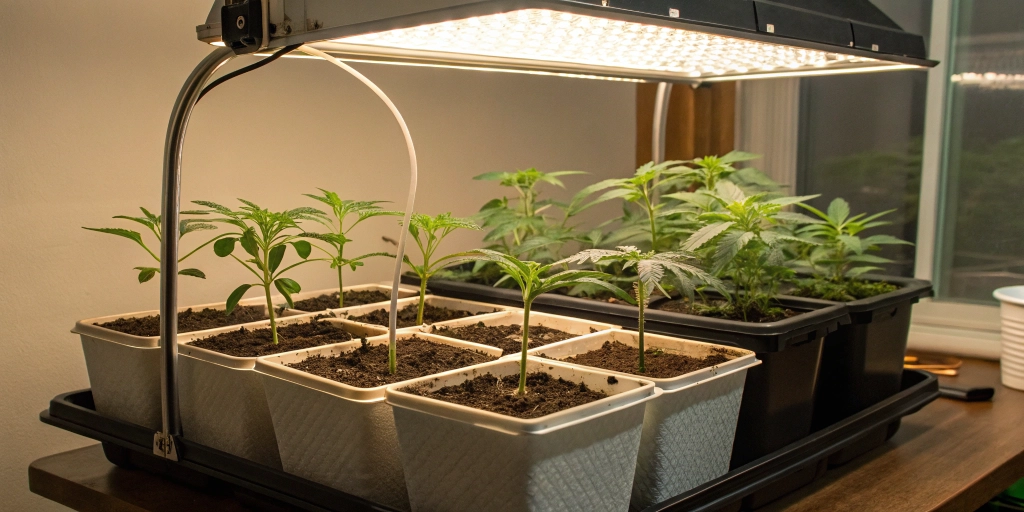
Once the shoot emerges above the growing medium, however, the seedling needs appropriate light for photosynthesis and compact development.
That is the point when lighting becomes a seedling-management issue rather than a germination issue.
What If a Cannabis Seed Does Not Sprout?
First, give it time.
Then check the basics:
- Is the medium still moist?
- Has it become waterlogged?
- Is the environment unusually cold?
- Did the paper towel dry out?
- Is the seed visibly moldy, collapsed or decaying?
Do not immediately cut, sand or crack a seed because it has not opened after a day or two.
Scarification methods have been studied in cannabis, but a comparative study did not find them statistically superior to the other germination treatments tested.
Older or unusually difficult seed lots may justify specialized techniques, but those should be treated as exceptions rather than the normal process.
Common Cannabis Seed Germination Mistakes
The most common mistake is overcomplicating germination.
Healthy seeds do not inherently need bleach, peroxide, air pumps, exact RH, scarification or multiple transfers between containers.
Another mistake is keeping the seed too wet. Germination requires moisture but also oxygen.
Waiting for an unnecessarily long exposed taproot creates additional handling risk.
And finally, do not discard seeds based purely on appearance or whether they float in water.
The most meaningful viability test is whether the seed actually germinates.
How to Sprout a Cannabis Seed: Bottom Line
The simplest method is direct sowing into a warm, moist and well-aerated growing medium.
A cannabis experiment comparing 13 germination treatments found no statistically significant differences among them, while direct sowing produced the numerically highest and most uniform germination result.
Paper towels also work well when you want to observe the root, and a short water soak can be used as an optional pre-hydration step.
Keep conditions warm, avoid waterlogging and transfer externally germinated seeds once the radicle becomes clearly visible.
You do not need a complicated chemical germination protocol to sprout a healthy cannabis seed.
FAQs About Sprouting Cannabis Seeds
What is the fastest way to sprout a cannabis seed?
There is no method proven to be universally fastest for every seed lot. Controlled cannabis research comparing direct sowing with water, peroxide, bleach and scarification treatments found no statistically significant difference in overall germination, while direct sowing produced the highest numerical and most uniform result.
Should you soak cannabis seeds before planting?
You can, but soaking is optional. A comparative cannabis study tested 18- and 24-hour water soaks and found no statistically significant germination advantage across the treatments evaluated. Healthy seeds can be sown directly into a moist growing medium without first being submerged in water.
How long should a cannabis taproot be before planting?
There is no required length. Once the seed coat opens and the white radicle is clearly visible, the seed has germinated and can be transferred. Waiting for a 1–2 cm exposed root is unnecessary and makes the delicate radicle more difficult to handle without damage.
What temperature should cannabis seeds germinate at?
Cannabis seeds germinate across a range of warm temperatures. A controlled hemp study found strong germination performance from roughly 19°C to 30°C, with germination speed highest toward the warmer end of that range. A stable low-to-mid-20s Celsius environment is therefore a practical home target.
Do cannabis seeds need darkness to germinate?
They do not need strong light during the actual germination phase. Cannabis research protocols commonly germinate seeds in darkness and introduce light as seedlings develop. Once the shoot emerges, appropriate lighting becomes important for photosynthesis and healthy seedling growth.
Why won’t my cannabis seed sprout?
Possible reasons include an old or nonviable seed, excessive water, drying, unsuitable temperature or physical deterioration. Some viable seeds also simply germinate more slowly than others. Maintain stable moisture and warmth before resorting to aggressive treatments such as cutting or scarifying the seed coat.