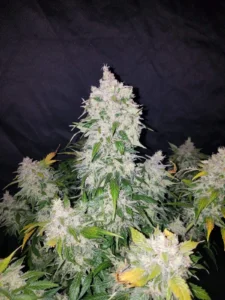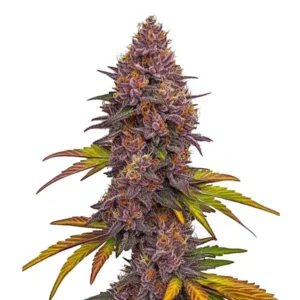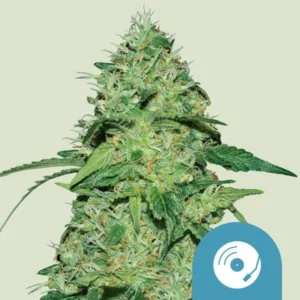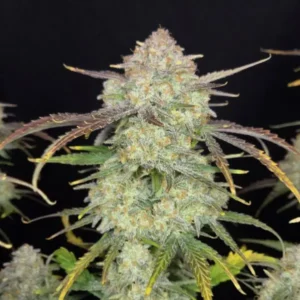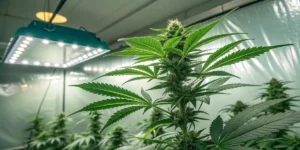


Frisian Duck is a feminized photoperiod hybrid from Dutch Passion created from Frisian Dew × DucksFoot. It is best known for its unusual webbed leaves, which resemble a duck’s footprint and make the plant look very different from conventional cannabis during much of its lifecycle.
The strain combines a balanced hybrid profile, 7–9 weeks of flowering, strong outdoor performance, substantial yield potential, and unusual purple flowers with spicy, pine, fruity, and citrus characteristics.
Recommended Strains

Frisian Duck

|
THC | 5% - 10% (Low) |

|
Lineage | Frisian Dew X Ducksfoot |

|
Type | Feminized |

|
Height | 7.38 ft | 2.25 m |

|
Yield | Medium |

|
Yield Indoor | 1.31 - 1.47 oz/ft² | 400 - 450 g/m² |

|
Yield Outdoor | 17.64 oz/plant | 500 g/plant |

|
Flowering Time | 7 - 9 weeks |

|
Phenotype | 50% Indica / 50% Sativa |

|
Effects | Uplifted, Happy, Relaxed |

|
Flavors | Citrus, Spicy, Pine, Mint |
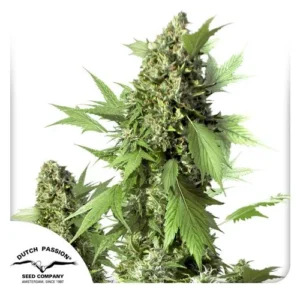
Auto Duck
|
|
THC | 15% - 20% (Medium) |
|
|
Lineage | Frisian Duck X Auto White Widow |
|
|
Type | Autoflowering |
|
|
Height | 4.27 ft | 1.3 m |
|
|
Yield | Low |
|
|
Yield Indoor | 1.15 oz/ft² | 350 g/m² |
|
|
Yield Outdoor | 3.53 oz/plant | 100 g/plant |
|
|
Life Cycle | 10 - 11 weeks |
|
|
Phenotype | 50% Indica / 50% Sativa |
|
|
Effects | Focused, Euphoric |
|
|
Flavors | Citrus, Fruity, Herbal |
Frisian Duck performs especially well outdoors and in greenhouses but can also be cultivated indoors. Outdoor plants can reach approximately 2–3 meters in favorable conditions, while indoor plants remain considerably easier to manage.
You can find Frisian Duck seeds and other Dutch Passion seeds at Growlantis.
Frisian Duck Grow Info
| Trait | Frisian Duck |
|---|---|
| Genetics | Frisian Dew × DucksFoot |
| Seed type | Feminized photoperiod |
| Indica / Sativa | Approximately 50% / 50% |
| THC | Moderate; Growlantis currently lists 5–10% |
| Flowering time | 7–9 weeks |
| Indoor yield | Approximately 400–500 g/m² |
| Outdoor height | Approximately 2–3 m |
| Yield potential | XXL |
| Best environments | Outdoor, greenhouse and indoor |
| Plant structure | Christmas-tree style with strong stems |
| Main feature | Webbed duck-foot leaves |
| Aroma / flavor | Spicy, fruity, pine, citrus and fresh forest |
| Reported effects | Uplifting with gentle physical relaxation |
These specifications are cultivation references rather than guarantees. Final size, yield, cannabinoid levels, color, and harvest time depend on phenotype and growing conditions.
What Is Frisian Duck?
Frisian Duck is a distinctive hybrid created from Frisian Dew and DucksFoot genetics.
Its most famous feature is the unusual shape of its leaves. Instead of developing the immediately recognizable separated leaflets associated with most cannabis plants, Frisian Duck produces fused or webbed leaves that resemble a duck’s footprint.
This characteristic is particularly visible during the first two-thirds of the plant’s lifecycle. As flowering progresses, some upper leaves can begin showing a more traditional cannabis shape.
Beyond its unusual appearance, Frisian Duck is a vigorous and productive cultivar capable of performing indoors, outdoors, and in greenhouses.
Its Frisian Dew ancestry also contributes strong outdoor performance, while the DucksFoot side is responsible for the distinctive leaf morphology that gives the strain its name.
Frisian Duck Genetics
The official Frisian Duck genetics are Frisian Dew × DucksFoot.
Frisian Dew contributes vigor, outdoor performance, resilience, and yield potential, while DucksFoot contributes the unusual webbed leaf structure.
The resulting cultivar is generally classified as an approximately balanced Indica/Sativa hybrid.
Frisian Duck can develop a strong central structure with substantial lateral branching, giving mature plants a Christmas-tree style appearance when allowed to grow naturally.
Some phenotypes also produce attractive purple flowers during bloom, particularly under outdoor conditions.
Because Frisian Duck and Frisian Dew are different cultivars, growers should not automatically transfer height, flowering time, or yield figures from one strain to the other.
Is Frisian Duck Indica or Sativa?
Frisian Duck is an approximately 50% Indica and 50% Sativa hybrid.
Its plant structure reflects both sides of the genetic background. Mature plants can become tall and vigorous outdoors while still developing dense flowers and substantial lateral branching.
The reported effects are also hybrid in character. Frisian Duck is generally described as uplifting and clear-headed while retaining a gentler physical relaxation.
The 50/50 classification should be treated as a description of the breeding line rather than a guarantee that every individual plant will develop the same structure, color, or final effect.
Why Does Frisian Duck Have Duck-Foot Leaves?
Frisian Duck’s most distinctive characteristic is its unusual webbed leaf shape.
The leaflets remain partly fused instead of separating into the familiar cannabis pattern, producing a shape that resembles a duck’s footprint.
This characteristic comes from the DucksFoot side of the genetic lineage.
The unusual leaf structure is strongest during vegetative development and the early part of flowering. Later in bloom, some upper leaves can develop a more conventional cannabis appearance.
This change is normal and does not indicate that the plant has lost its genetic characteristics.
The unusual foliage is primarily a morphological trait and should not be interpreted as providing protection from insects or other pests.
Frisian Duck Plant Height
Frisian Duck can become a substantial outdoor plant.
Under favorable outdoor conditions, plants can reach approximately 2–3 meters in height. Greenhouse specimens can also become extremely large when given enough root space and a long vegetative season.
Indoor plants generally remain easier to control because growers determine how long the vegetative period lasts before switching to flowering.
Older breeder specifications have placed indoor height around 1.5 meters, but final size can vary considerably with vegetative duration, root volume, training, lighting, and phenotype.
Outdoor growers should plan enough horizontal space as well as vertical clearance because well-developed Frisian Duck plants can produce strong lateral branches.

Frisian Duck Flowering Time
Frisian Duck normally requires approximately 7–9 weeks of flowering.
For indoor plants, this period begins after the light cycle is changed to 12 hours of light and 12 hours of uninterrupted darkness.
It does not include germination or vegetative growth.
Because Frisian Duck is photoperiod dependent, there is no universal total seed-to-harvest time. Indoor growers decide how long plants remain in vegetation, while outdoor flowering begins naturally as seasonal day length decreases.
Individual phenotypes can finish toward either end of the 7–9 week range, so the breeder timeline should guide inspection rather than operate as an automatic harvest deadline.
Growing Frisian Duck Outdoors
Frisian Duck is particularly well suited to outdoor cultivation.
The plant was bred as part of a line focused heavily on outdoor performance and can develop into a large, productive specimen when given sufficient sunlight, root space, and growing time.
Choose a position with strong direct sunlight and well-draining soil. Large plants also need enough distance from neighboring vegetation for branches to expand freely and for air to move through the canopy.
The plant’s strong stems support substantial flowers, but exceptionally large outdoor specimens may still benefit from support as flower weight increases.
Because plants can reach approximately 2–3 meters, topping or low-stress training can be useful where final height needs to be controlled.
Best Climate for Frisian Duck
Frisian Duck is particularly well suited to temperate outdoor environments and performs strongly under conditions where some more climate-sensitive cultivars can struggle.
Its Frisian Dew ancestry contributes resilience and makes the plant especially attractive for growers in Northern European-style climates.
Strong sunlight remains beneficial, even though the strain can handle variable outdoor conditions.
Good drainage is also important. A cultivar adapted to outdoor humidity still does not benefit from roots remaining permanently waterlogged.
Growers in cooler regions should take advantage of the full spring and summer vegetative period so the plant has enough time to develop before autumn flowering and harvest.
Growing Frisian Duck in a Greenhouse
Frisian Duck can perform exceptionally well in greenhouse environments.
Natural sunlight supports vigorous development while the structure provides additional protection from prolonged rainfall, wind, and sudden environmental changes.
The main challenge is space. Greenhouse-grown plants can become very large, so both roof height and lateral room should be considered before planting.
Ventilation also remains essential.
A greenhouse protects plants from direct rain but can trap substantial humidity produced through transpiration. Large flowering plants can therefore create humid microclimates if fresh air is not exchanged effectively.
Good ventilation and sensible spacing allow growers to take advantage of Frisian Duck’s vigorous growth without creating an excessively dense environment.
Growing Frisian Duck Indoors
Unlike some outdoor-specialized cultivars, Frisian Duck can also be grown indoors.
Indoor plants follow a conventional photoperiod lifecycle. A longer light schedule such as 18/6 can be used during vegetative development, followed by 12/12 when the grower wants flowering to begin.
The breeder describes Frisian Duck as relatively manageable indoors and not excessively difficult to control vertically.
Indoor growers can use vegetative duration to determine final plant size. Switching earlier keeps plants smaller, while a longer vegetative period creates a broader canopy.
The characteristic webbed leaves remain visible indoors, although purple coloration can sometimes be less pronounced than it is on outdoor-grown plants.
Frisian Duck Yield
Frisian Duck is currently classified by Dutch Passion as an XXL-yielding cultivar.
Indoors, approximately 400–500 g/m² is possible under favorable conditions.
Outdoor yield is much harder to represent with one universal grams-per-plant figure because final production depends strongly on plant size. A large plant with substantial root space and a complete outdoor season has significantly more production potential than one grown in a restricted container.
For that reason, the breeder’s XXL classification is more useful than assuming every outdoor Frisian Duck produces one fixed amount.
Actual yield depends on lighting, sunlight, canopy size, root volume, growing season, training, nutrition, water availability, climate, and phenotype.
Training Frisian Duck
Frisian Duck naturally develops a Christmas-tree style structure with strong stems and good branching.
Growers who have sufficient outdoor space can allow the plant to develop naturally with minimal intervention.
Where height needs to be controlled, topping once during healthy vegetative growth can encourage a shorter and wider plant.
Low-stress training can also redirect vigorous branches outward and expose more flowering sites to light.
Avoid unnecessary heavy defoliation simply because the leaves have an unusual appearance. The webbed foliage is a normal genetic characteristic and remains important for photosynthesis.
Selective pruning should focus on genuinely overcrowded or poorly positioned growth rather than trying to make the plant look like conventional cannabis.

Frisian Duck Grow Stages
A Frisian Duck grow is better understood through developmental stages than through a rigid week-by-week calendar because vegetative duration depends on the cultivation environment.
Germination and Seedling Stage
Frisian Duck seeds do not require a unique germination method.
Stable warmth, moisture, oxygen, and gentle handling are the main priorities. Once the first root emerges, transfer the seed carefully into a suitable medium and avoid maintaining permanently saturated conditions.
For more information, see how long cannabis seeds take to germinate.
Vegetative Growth
During vegetation, Frisian Duck develops its distinctive webbed leaves and builds the branch structure needed for flowering.
Indoor growers can control the duration through the photoperiod. Outdoor plants remain in vegetative growth naturally while summer days stay long.
This is the most useful stage for topping or LST if final height needs to be controlled.
Flowering Transition
As flowering begins, new flower sites appear while the plant continues structural development.
The webbed leaf shape remains visible, although some upper foliage can gradually begin looking more conventional.
Major structural training should generally be completed before flowers become heavily developed.
Late Flowering
During the later portion of the 7–9 week flowering period, the buds become increasingly large and resinous.
Purple coloration can become prominent in some phenotypes, while others remain greener.
Focus on stable environmental conditions, branch support where needed, airflow, appropriate irrigation, and flower maturity.
Feeding Frisian Duck
Frisian Duck does not require one official strain-specific NPK ratio.
During vegetative growth, use a balanced feeding program appropriate to the growing medium and nutrient system that supports healthy root, stem, and foliage development.
Once flowering begins, transition toward a suitable bloom-oriented formula according to the fertilizer system being used.
There is no need to treat a 3-1-2 ratio during vegetation or a 1-3-2 ratio during flowering as mandatory characteristics of Frisian Duck.
Nutrient concentration should instead reflect plant size, medium, water quality, root development, and actual response.
High yield potential does not mean the plant benefits from unlimited fertilizer.
Watering Frisian Duck
Water Frisian Duck according to root-zone conditions rather than a fixed schedule.
Young plants initially use small amounts of water because their root systems occupy only a limited area. Mature outdoor plants can require much larger volumes as the canopy and root system expand.
Soil, containers, temperature, light, humidity, and wind all influence how quickly moisture is consumed.
Allow enough oxygen to return to the root zone between irrigations instead of maintaining permanently saturated soil.
Large outdoor or greenhouse plants can consume substantial amounts during warm summer weather, but good drainage remains important regardless of plant size.
Airflow and Mold Prevention
Frisian Duck has a relatively open hybrid flower structure and good outdoor resilience, but proper airflow remains important.
Large plants can develop dense interior growth if branches are allowed to overlap excessively.
Good spacing, selective pruning, and gentle air circulation help moisture leave the canopy after rainfall or during humid conditions.
Greenhouse growers should pay particular attention to ventilation because large plants can release substantial moisture into enclosed spaces.
Outdoor resilience should not be interpreted as immunity to fungal problems.
When to Harvest Frisian Duck
Frisian Duck generally reaches maturity after approximately 7–9 weeks of flowering.
Outdoors, harvest timing depends on latitude and seasonal conditions, with the plant generally finishing around the beginning to middle of autumn in Northern Hemisphere environments.
Use the expected flowering range to determine when close inspection should begin rather than harvesting automatically on a specific date.
Evaluate flower development and trichome maturity alongside upcoming weather conditions.
Some upper leaves becoming more conventionally shaped late in flowering is a normal trait of Frisian Duck and should not be confused with a maturity signal.
Frisian Duck THC
Frisian Duck is currently classified by Dutch Passion as a medium-THC cultivar.
Growlantis currently lists approximately 5–10% THC, which is consistent with older Dutch Passion specifications for this strain.
The breeder’s modern product page no longer provides one exact numerical THC percentage, so 5–10% is better treated as a current Growlantis catalog reference rather than a guaranteed laboratory range.
Actual cannabinoid levels can vary according to phenotype, environment, light, plant health, harvest timing, drying, curing, and analytical method.
Claims that Frisian Duck universally contains 14–17% THC should therefore not replace the current breeder and Growlantis information.
Frisian Duck Effects
Frisian Duck is generally described as producing a balanced hybrid effect.
The experience tends toward an uplifting and clear-headed character while retaining gentle physical relaxation.
Individual responses can differ according to dose, tolerance, phenotype, cannabinoid profile, and final flower quality.
The moderate potency makes Frisian Duck distinct from cultivars bred primarily around extremely high THC percentages.
These descriptions should be treated as general reported characteristics rather than guaranteed effects, and they should not be converted into claims that the strain treats anxiety, stress, pain, or other medical conditions.
Frisian Duck Flavor and Aroma
Frisian Duck has a relatively subtle but distinctive sensory profile.
Dutch Passion describes the flowers with spicy, piney, fruity, citrus, berry, and fresh-forest characteristics.
Some phenotypes can express more pronounced citrus notes, while others lean more heavily toward pine and spice.
The aroma is generally less pungent than many conventional cannabis strains, although mature flowers still produce a recognizable scent.
Growing conditions, phenotype, harvest maturity, drying, and curing all influence the final expression, so one exact terpene ranking should not be presented as universal without analytical data.
Frisian Duck vs Auto Duck
Frisian Duck and Auto Duck are related but different cultivars.
Frisian Duck is a feminized photoperiod strain based on Frisian Dew × DucksFoot. Indoor growers control when flowering begins by changing the light schedule.
Auto Duck contains autoflowering genetics and flowers according to age instead of requiring a 12/12 photoperiod trigger.
Its genetics, lifecycle, height, yield, and potency differ from the Frisian Duck covered in this guide.
Searches for “Frisian Duck Auto” can therefore be misleading. Growers should confirm whether they have Frisian Duck or Auto Duck before following a cultivation timeline.
Frisian Duck Strain Review
From a cultivation perspective, Frisian Duck stands out primarily because it combines unusual leaf morphology with versatile growing characteristics.
It can be cultivated indoors, but its strongest appeal is outdoor and greenhouse cultivation, where plants can take advantage of more space and express their vigorous structure.
The 7–9 week flowering period is relatively manageable for a photoperiod hybrid, while the XXL yield classification gives it strong production potential.
Its moderate potency also distinguishes it from many modern cultivars selected primarily for maximum THC.
Growers choosing Frisian Duck are therefore usually selecting for a combination of unusual morphology, outdoor performance, yield potential, balanced effects, and a less extreme cannabinoid profile.
Common Problems When Growing Frisian Duck
Confusing Frisian Duck With Auto Duck
Frisian Duck is photoperiod dependent, while Auto Duck is an autoflower. Applying an automatic lifecycle to Frisian Duck or waiting for a photoperiod switch when growing Auto Duck can lead to incorrect cultivation planning. Always confirm the exact seed type before following flowering or harvest timings.
Using the Wrong THC Figure
The current Growlantis listing places Frisian Duck at 5–10% THC, while Dutch Passion now classifies the cultivar simply as medium THC. Older or generic claims of 14–17% should not be treated as more authoritative than the specifications attached to the actual seed line being grown.
Underestimating Outdoor Size
Frisian Duck can reach approximately 2–3 meters outdoors. Growers expecting a compact plant can quickly run out of vertical or lateral space. Topping and low-stress training during vegetative growth are much easier than trying to reduce plant size once flowering is already advanced.
Treating Webbed Leaves as a Problem
Frisian Duck’s fused leaflets are a stable genetic characteristic, not a nutrient deficiency or disease symptom. Some upper leaves can become more conventional during flowering. Growers should evaluate plant health using color, vigor, root conditions, and other symptoms rather than trying to correct the natural leaf shape.
Following a Fixed Nutrient Ratio
There is no official Frisian Duck feeding schedule requiring exact 3-1-2 or 1-3-2 NPK ratios. Nutrient requirements depend on the growing medium, fertilizer system, water quality, plant size, growth stage, and actual response. Fixed strain-specific formulas can create unnecessary overfeeding.

FAQs About Frisian Duck
Why does Frisian Duck have unusual leaves?
Frisian Duck inherits its distinctive webbed leaves from its DucksFoot genetics. The leaflets remain partly fused and resemble a duck’s footprint, especially during the first two-thirds of the plant’s life. As flowering progresses, some upper leaves can develop a more conventional cannabis shape, which is a normal characteristic of this cultivar.
What is the Frisian Duck flowering time?
Frisian Duck normally requires approximately 7–9 weeks of flowering. Indoor growers begin this period after switching photoperiod plants to 12/12, while outdoor flowering starts naturally as days shorten. Phenotype and growing conditions can shift maturity slightly, so growers should confirm actual flower development before harvesting.
How tall does Frisian Duck grow?
Frisian Duck can reach approximately 2–3 meters outdoors in favorable conditions, while indoor plants are generally easier to control through vegetative duration and training. Final height depends on root space, light, climate, planting time, phenotype, and cultivation method, so these figures should be used as planning references rather than fixed limits.
Can Frisian Duck be grown indoors?
Yes. Frisian Duck can be grown indoors as a conventional feminized photoperiod plant. The breeder describes it as relatively manageable indoors, although outdoor and greenhouse cultivation remain particularly well suited to its genetics. Indoor growers can control final size by adjusting vegetative duration and using topping or low-stress training where necessary.
How much does Frisian Duck yield?
Frisian Duck is classified as an XXL-yielding cultivar. Indoors, approximately 400–500 g/m² is possible under favorable conditions. Outdoor production depends heavily on plant size, root space, sunlight, growing season, climate, and training, so one universal grams-per-plant figure is less useful than the breeder’s overall XXL yield classification.
Is Frisian Duck the same as Frisian Duck Auto?
No. Frisian Duck is a feminized photoperiod strain created from Frisian Dew × DucksFoot. Auto Duck is a separate autoflowering cultivar containing Frisian Duck and autoflower genetics. The two have different flowering triggers, lifecycles, heights, yields, and potency, so cultivation instructions should not be used interchangeably.