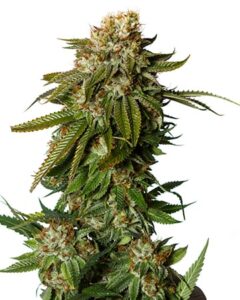


Glookies is an indica-dominant feminized photoperiod strain from Barney’s Farm created from GG4 and Thin Mint Girl Scout Cookies genetics. It is classified as 70% Indica and 30% Sativa and combines strong lateral branching with very high production potential indoors and outdoors.
Current Glookies seeds flower in approximately 60–70 days. Barney’s Farm lists plants at 100–120 cm indoors and 120–180 cm outdoors, with yields of 700–800 g/m² indoors and 2,000–3,000 g per plant outdoors under favorable conditions.
Recommended Strains

Glookies

|
THC | 22% - 25% (High) |

|
Lineage | GG x Thin Mint Girl Scout Cookies |

|
Type | Feminized |

|
Height | 4.92 ft | 1.5 m |

|
Yield | High |

|
Yield Indoor | 2.29 - 2.62 oz/ft² | 700 - 800 g/m² |

|
Yield Outdoor | 21.16 - 28.22 oz/plant | 600 - 800 g/plant |

|
Flowering Time | 8 - 10 weeks |

|
Phenotype | 70% Indica / 30% Sativa |

|
Medical | Fatigue, Muscle Spasms, Stress |

|
Effects | Energetic, Euphoric, Relaxed |

|
Flavors | Diesel, Lime |

Glookies Auto
|
|
THC | 22% - 25% (High) |
|
|
Lineage | GG x Girl Scout Cookies x Ruderalis |
|
|
Type | Autoflowering |
|
|
Height | 4.92 ft | 1.5 m |
|
|
Yield | High |
|
|
Yield Indoor | 1.64 - 1.97 oz/ft² | 500 - 600 g/m² |
|
|
Yield Outdoor | 2.82 - 5.29 oz/plant | 80 - 150 g/plant |
|
|
Life Cycle | 8 - 10 weeks |
|
|
Phenotype | 70% Indica / 30% Sativa |
|
|
Medical | Fatigue, Muscle Spasms, Stress |
|
|
Effects | Energetic, Euphoric, Relaxed |
|
|
Flavors | Diesel, Lime |
| Glookies Grow Info | Current specification |
|---|---|
| Breeder | Barney’s Farm |
| Genetics | GG4 × Thin Mint Girl Scout Cookies |
| Seed type | Feminized photoperiod |
| Indica / Sativa | 70% Indica / 30% Sativa |
| THC | 29% on current US breeder page; 32% on current global page |
| Flowering time | 60–70 days |
| Indoor height | 100–120 cm |
| Outdoor height | 120–180 cm |
| Indoor yield | 700–800 g/m² |
| Outdoor yield | 2,000–3,000 g/plant |
| Outdoor harvest | October, 1st–2nd week |
| Taste | Sour Diesel, Key Lime, Walnut |
| Aroma | Nutty, Key Lime, Exotic |
| Reported effects | Relaxing, Motivated, Energetic |
Glookies Genetics
Glookies combines GG4 with Thin Mint Girl Scout Cookies, bringing together two well-known modern cannabis lines in a strongly indica-dominant photoperiod hybrid.
Barney’s Farm describes the plant as developing extensive side branching and large resinous flowers. That growth pattern is especially relevant for cultivation because it gives the plant considerable canopy-building potential without requiring the extreme height associated with many Sativa-dominant cultivars.
Growers interested in other genetics from the same breeder can browse the wider Barney’s Farm seed collection.
Glookies is photoperiodic, so indoor growers decide when flowering begins by changing the light schedule rather than waiting for an age-driven automatic transition.
Is Glookies Indica or Sativa?
Glookies is 70% Indica and 30% Sativa, making it clearly indica dominant.
Its relatively compact indoor height and strong branching fit that classification, although the plant can still produce a wide productive canopy when given enough vegetative development.
Barney’s Farm describes the reported effects as relaxing, motivating and energetic. These characteristics show why an Indica/Sativa percentage should not be treated as a simple prediction of sedation or stimulation.
Phenotype, dose, tolerance and the chemical composition of an individual harvest can all influence the final experience.
How Much THC Does Glookies Have?
Current Barney’s Farm regional pages do not publish exactly the same THC figure.
The current US breeder page lists 29% THC, while the global Barney’s Farm page currently lists 32% THC. Because Growlantis.com serves the US market, 29% is the more appropriate reference for the commercial product page.
For a general Glookies grow guide, the most accurate approach is to acknowledge the current 29–32% official regional discrepancy rather than presenting one number as universally settled.
In either case, Glookies is currently positioned as a very high-THC cultivar.
Glookies Flavor and Aroma
The current breeder profile describes Glookies with Sour Diesel, Key Lime and Walnut flavors.
Its aroma is described as nutty, Key Lime and exotic, creating a combination of fuel, citrus and nut-like characteristics rather than the generic earthy-and-sweet description found in some older content.
These sensory details are better supported than assigning one universal terpene hierarchy to the strain.
Although older Growlantis copy lists individual compounds such as myrcene, caryophyllene and limonene, the current breeder product specification does not provide a quantitative terpene analysis that establishes those three as the definitive profile.
Glookies Flowering Time
Glookies flowers for approximately 60–70 days after the indoor flowering transition.
Because Glookies is photoperiodic, this flowering period does not begin at one predetermined plant age. Indoor growers decide when bloom begins by changing the light schedule to approximately 12 hours of light and 12 hours of uninterrupted darkness.
That distinction matters because an eight-week-old plant is not automatically ready to flower. A grower working in a smaller space may initiate flowering much earlier, while a larger room can support additional vegetative development.
From the 12/12 transition onward, the current 60–70 day breeder range is the primary timing reference.
For more context on the changes that occur after the light-cycle transition, see the cannabis flowering stage guide.

Glookies Height and Plant Structure
Barney’s Farm currently lists Glookies at approximately 100–120 cm indoors and 120–180 cm outdoors.
These separate environment-specific measurements are more useful than describing the plant with one universal 1.5 m height.
Glookies develops substantial lateral branching, which can create a broad canopy despite the manageable indoor height. This structure also helps explain its strong yield potential, as multiple productive branches can carry large flowering sites when exposed to sufficient light.
Indoor growers can still influence final size through vegetative duration, root volume and training. The plant should therefore be managed according to available room rather than one fixed expected height.
Growing Glookies Indoors
Current breeder specifications list Glookies at approximately 700–800 g/m² indoors.
Its 100–120 cm indoor height makes it manageable in many controlled spaces, but its extensive side branching means horizontal canopy room should be considered alongside vertical clearance.
There is no fixed vegetative duration required to reach the published yield. Indoor growers can keep Glookies in vegetative growth until its branch structure and canopy fit the intended flowering area.
Once the plant is ready, flowering is initiated by changing the light cycle. The aim should be a well-distributed canopy with enough room for productive branches to continue developing without excessive overlap.
Growing Glookies Outdoors
Outdoor Glookies can become substantially more productive than older Growlantis data suggested.
Barney’s Farm currently lists the plant at approximately 120–180 cm outdoors with production potential of 2,000–3,000 g per plant under ideal conditions.
The breeder gives a Northern Hemisphere harvest window of the first to second week of October.
Those large production figures depend on favorable sunlight, root space, climate and plant health. They should be treated as genetic potential rather than an expected harvest from every outdoor plant.
Because Glookies develops extensive branching, provide enough spacing for the canopy to expand without heavily overlapping neighboring plants.
Glookies Yield
Current Glookies yield specifications are approximately 700–800 g/m² indoors and 2,000–3,000 g per plant outdoors.
The outdoor figure is dramatically higher than the 600–800 g per plant found in older versions of the Growlantis guide and should be updated.
Indoor production is expressed by canopy area because plant count and vegetative duration can vary considerably. Outdoor production is measured per plant because the plant has much greater access to root and canopy space.
Neither figure guarantees a specific harvest. Light, root volume, growing-season length, canopy management and plant health all influence final production.
How to Germinate Glookies Seeds
Barney’s Farm recommends the paper-towel method for germinating Glookies.
Seeds can be placed between damp paper towels in a warm, dark environment and kept consistently moist until a taproot emerges. The breeder currently recommends a germination temperature range of approximately 70–90°F, or 21–32°C.
Once the root appears, the seed can be transferred carefully into an appropriate growing medium with the root pointing downward. Avoid damaging the newly emerged taproot during handling.
For more detail on controlling moisture and temperature during this stage, see the cannabis seed germination temperature and humidity guide.

Vegetative Growth
Glookies does not have a fixed vegetative duration.
As a photoperiod cultivar, it remains in vegetative growth until the indoor grower changes the light schedule. This allows plant size to be adapted to the available space rather than following an arbitrary week number.
The strain’s strong side branching makes the vegetative stage particularly useful for canopy development. Healthy lateral branches can be positioned and shaped before the flowering stretch begins.
Growers with limited room can initiate flowering earlier, while larger spaces can support additional vegetative growth.
The correct transition point is determined by plant structure, root development and available space rather than the age of the plant.
Training Glookies
Glookies’ extensive lateral branching gives growers several reasonable options for canopy management.
Gentle low-stress training can spread branches outward and improve access to light across the canopy. Topping during healthy vegetative growth can also reduce dominance of the central stem when the plant has enough recovery time before flowering.
A ScrOG setup can be useful where growers want to distribute the side branches across a wider, flatter area.
These techniques should be used to control structure and light distribution rather than presented as guarantees of higher THC or a specific yield.
As flowers gain weight later in the cycle, branch support may become more useful than continued structural training.
Flowering Development
After the 12/12 transition, Glookies enters a flowering period of approximately 60–70 days.
The plant can continue adding some height and branch length during the early transition while flower sites become established. As bloom progresses, the flowers become increasingly dense and resinous and the Sour Diesel, Key Lime and nutty aromatic profile becomes more noticeable.
Because the plant can carry a large amount of flowering material across its lateral branches, maintaining space within the canopy becomes increasingly useful later in bloom.
Use the 60–70 day range as a planning guide while assessing actual flower maturity rather than assuming every phenotype will finish on exactly the same day.
Feeding Glookies
Glookies does not require one universal strain-specific nutrient formula.
Feeding should reflect the growing medium, fertilizer system, water quality, root volume, plant size and visible response. There is no need to prescribe one high-nitrogen vegetative formula or automatically push large amounts of phosphorus and potassium during flowering.
A plant that develops strongly may consume more nutrients as its canopy expands, but increased fertilizer concentration does not automatically produce more resin, terpenes or potency.
Burned leaf tips, excessively dark foliage, stalled growth or progressive discoloration provide more useful information than following a rigid Glookies nutrient calendar.
Watering Glookies
Water requirements change substantially as Glookies develops.
A young plant with a limited root system needs far less water than a mature flowering plant supporting a large canopy. In containers, substrate moisture and pot weight can provide more useful guidance than watering according to a fixed number of days.
Ensure that excess water can drain rather than leaving the root zone permanently saturated.
Outdoor plants can use large quantities of water during warm weather, particularly when they develop toward the upper end of the outdoor size and yield range, but irrigation should still respond to soil conditions, recent weather and actual plant demand.
Airflow and Dense Flowering Growth
Glookies develops substantial side branching and heavy flowering sites, so canopy airflow becomes increasingly relevant as bloom progresses.
Avoid relying only on a room-level humidity reading. Overlapping branches and dense flowers can create localized areas where moisture remains higher than the general environment.
Gentle circulation above, through and below the canopy can help reduce stagnant zones while ventilation removes excess moisture from the grow space.
Training and selective canopy management can also create more room between branches without requiring aggressive leaf removal.
Common Glookies Growing Problems
Canopy congestion is one practical issue to monitor because Glookies produces extensive side branching and large flowering sites.
Overwatering and excessive nutrient concentration are broader cultivation problems rather than documented Glookies-specific weaknesses. Diagnose them from actual root-zone conditions and plant symptoms rather than assuming the strain always needs strong feeding.
The current breeder specification also does not establish a universal mold- or pest-resistance rating, so Glookies should not be treated as immune to either problem.
Finally, avoid initiating flowering according to a fixed age. Glookies is photoperiodic, and indoor flowering begins when the grower changes the light schedule.
Glookies vs Glookies Auto
Glookies and Glookies Auto require different cultivation planning.
The Glookies covered in this guide is a feminized photoperiod strain built from GG4 × Thin Mint Girl Scout Cookies. Indoor growers control how long vegetation lasts and then initiate a 60–70 day flowering stage with a light-cycle change.
Glookies Auto is a separate autoflowering cultivar that contains Ruderalis genetics and transitions according to age rather than photoperiod.
Its height, outdoor yield and seed-to-harvest timeline should therefore not be transferred into this guide.
If you are growing the automatic version, use the dedicated Glookies Auto grow guide.
When to Harvest Glookies
Indoor Glookies generally reaches its expected harvest window after approximately 60–70 days of flowering.
Outdoors, Barney’s Farm currently lists harvest around the first to second week of October in the Northern Hemisphere.
Use these figures as planning ranges rather than automatic cutting dates.
As the expected window approaches, inspect flower development and trichome maturity directly. There is no need to require one fixed amber-trichome percentage for every Glookies phenotype or to promise a particular effect based solely on one trichome ratio.
Glookies Effects
Barney’s Farm currently describes Glookies as producing relaxing, motivating and energetic reported effects.
Its 70% Indica classification does not mean every experience will be strongly sedating, and the breeder’s own description emphasizes motivational energy alongside physical relaxation.
The current official THC figures are very high, although Barney’s regional pages differ on the exact percentage.
Effects remain subjective and can vary according to dose, tolerance and the chemical profile of an individual harvest. They should not be presented as medical or therapeutic outcomes.

Glookies FAQs
How long does Glookies take to flower?
Glookies has a current breeder-listed flowering time of approximately 60–70 days after the indoor light schedule is changed to flowering. This is not the full seed-to-harvest timeline because Glookies is photoperiodic. The grower controls how long the plant remains in vegetative growth before initiating the 12/12 flowering phase.
Is Glookies Indica or Sativa?
Glookies is an indica-dominant hybrid classified as 70% Indica and 30% Sativa by Barney’s Farm. Its genetics combine GG4 with Thin Mint Girl Scout Cookies. The ratio describes the seed line itself, while final plant structure and reported effects can still vary somewhat with phenotype, environment, dose and individual response.
How much THC does Glookies have?
Barney’s Farm currently publishes different THC figures on its regional sites: the US page lists 29%, while the global page lists 32%. Because Growlantis.com serves the US market, 29% is the most appropriate product reference there. The broader guide can acknowledge the current 29–32% official regional discrepancy.
How much does Glookies yield?
Current breeder specifications list Glookies at approximately 700–800 g/m² indoors and 2,000–3,000 g per plant outdoors under favorable conditions. These are production-potential figures rather than guaranteed harvests. Light, root space, vegetative duration, climate, plant health and canopy management can all substantially change the final weight of an individual crop.
How tall does Glookies grow?
Barney’s Farm currently lists Glookies at approximately 100–120 cm indoors and 120–180 cm outdoors. Indoor growers can further influence final size through vegetative duration, container volume and training. These environment-specific figures are more useful than older Growlantis listings that describe the strain with one universal 1.5 m height.
Is Glookies an autoflower?
No. Glookies is a feminized photoperiod strain, so indoor flowering is initiated by changing the light schedule. Glookies Auto is a separate autoflowering cultivar with Ruderalis genetics and a fixed age-driven lifecycle. Its height, yield, flowering behavior and cultivation timeline should not be transferred to the photoperiod Glookies covered in this guide.