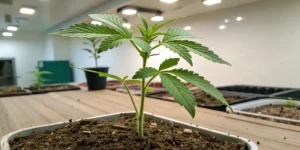
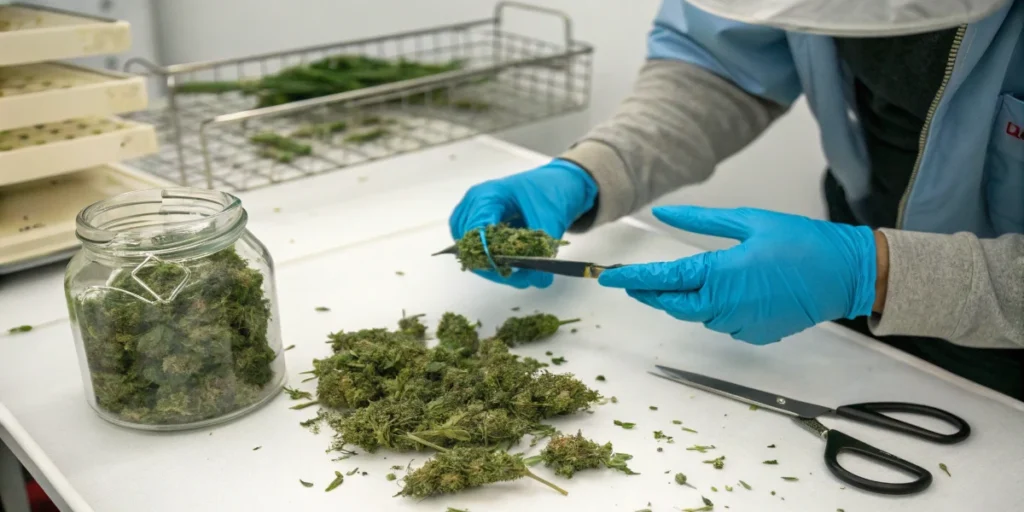

Cross-contamination in cannabis handling occurs when microorganisms, chemicals, foreign material or residues move from workers, tools, surfaces, equipment or one batch of cannabis to another. Trimming and other post-harvest stages create repeated contact opportunities, so effective prevention depends on cleanable equipment, worker hygiene, separation of dirty and clean activities, moisture control and verified sanitation procedures.
What Is Cross-Contamination in Cannabis Handling?
Cross-contamination is the transfer of an unwanted contaminant from one source to another. In a cannabis processing environment, this can happen when contaminated flower contacts clean trimming equipment, an employee touches cannabis after handling an unsanitary surface, residue remains on shared machinery between batches, or contaminated waste moves through a clean processing area.
Recommended Strains

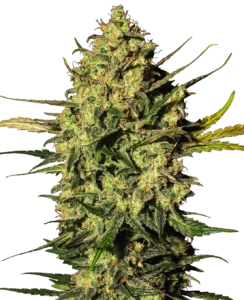
Master Kush

|
THC | 14% - 16% (Medium) |

|
Lineage | Hindu Kush |

|
Type | Feminized |

|
Height | 4.59 ft | 1.4 m |

|
Yield | High |

|
Yield Indoor | 1.64 - 1.8 oz/ft² | 500 - 550 g/m² |

|
Flowering Time | 8 - 9 weeks |

|
Phenotype | 90% Indica / 10% Sativa |

|
Effects | Relaxed, Calming, Hungry |

|
Flavors | Earthy, Citrus, Spicy |
This distinction matters because contamination and cross-contamination are related but not identical. A cannabis flower can already carry microorganisms when it enters the trimming room. Cross-contamination occurs when those organisms or other contaminants subsequently move to another flower, contact surface, container, tool or batch.
Post-harvest processing deserves particular attention because cannabis flower naturally supports a complex microbial community. Studies have identified fungi including Penicillium, Aspergillus, Cladosporium and Fusarium on cannabis inflorescences, while processing and handling conditions can influence the final microbial load.
Why Trimming and Post-Harvest Handling Create Contamination Risks
Cannabis flower passes through numerous contact points after harvest. It may be cut, transported, dried, bucked from stems, trimmed, sorted, weighed and packaged. At every stage, the material can interact with workers, tools, tables, trays, containers and the surrounding air.
Research supports the idea that these stages can alter microbial levels. One study of high-THC cannabis found that harvesting activity by workers, drying method, environmental conditions and inadequate drying were among the factors associated with differences in total yeast and mold levels. Another review concluded that microorganisms can accumulate during multiple post-harvest stages and highlighted equipment cleaning and careful handling as important control measures.
Mechanical processing can introduce additional opportunities for spread. Research examining cannabis pathogens found that mechanical trimming increased the frequency of some Penicillium species, potentially because cutting creates wounds and because machinery can distribute organisms between plant tissues.
That does not mean trimming itself makes cannabis unsafe. It means trimming should be treated as a controlled processing step rather than a purely cosmetic one.
The Main Sources of Cannabis Cross-Contamination
Workers are one obvious pathway because hands and clothing repeatedly contact flower, equipment and the surrounding environment. However, focusing only on employees misses much of the risk. Contact surfaces, trimming machines, scissors, trays, bins, air movement, waste, incoming material and even cleaning chemicals can become contamination pathways when procedures are poorly designed.
Health Canada’s cannabis Good Production Practices guidance identifies employees, contact surfaces, air, water, incoming materials and the processing or storage environment among potential sources of biological hazards. It also emphasizes equipment design, sanitation, employee hygiene and separation of incompatible activities as parts of contamination prevention.
This is a better way to approach the problem than assuming contamination comes from one source. A strong program looks at how product, people, equipment and waste move through the entire facility.
Microbial Cross-Contamination
Microbial contamination is one of the most important concerns because dried cannabis can carry yeasts and molds, including organisms that may be undesirable from either product-quality or consumer-safety perspectives.
Cannabis research has identified Aspergillus, Penicillium, Fusarium and Cladosporium among fungi associated with flowers and cultivation environments. Some fungal species can produce mycotoxins or pose particular risks to susceptible consumers, although the health significance varies greatly by species and exposure.
Bacterial organisms are also relevant to cannabis safety testing. Microbiological testing frameworks in regulated U.S. markets can include targets such as Salmonella, Shiga toxin-producing E. coli and certain Aspergillus species, although exact requirements differ by jurisdiction.
For that reason, an article should avoid saying simply that “all bacteria are dangerous.” Cannabis naturally contains microorganisms. The objective is to control undesirable microbial loads and specific organisms of concern rather than pretend that flower can or should exist in a microbiologically sterile state.
Should You Wear Gloves When Trimming Cannabis?
Gloves can be a useful barrier between workers and cannabis, but wearing gloves is not enough by itself.
A contaminated glove can transfer microorganisms or residues just as a contaminated hand can. If an employee touches a phone, door handle, waste container, dirty equipment or another potentially contaminated surface and then returns to handling flower with the same gloves, the gloves have ceased functioning as an effective hygiene barrier.
The more important concept is controlled hand and glove hygiene. Workers should follow a defined procedure for cleaning hands and changing gloves whenever contamination is reasonably possible. Health Canada’s production guidance similarly emphasizes employee hygiene requirements and accessible hand-cleaning and sanitizing facilities as part of contamination prevention.
There is also no reason to claim that gloves must be changed simply because the commercial strain name changes. The meaningful boundary is contamination risk or batch-control requirements, not whether the label says Gelato instead of Kush.
Cleaning Trimming Scissors, Tables and Equipment
Cannabis-contact equipment should be designed so that surfaces can actually be cleaned. Cracks, difficult-to-access joints, damaged surfaces and accumulated sticky resin can make effective sanitation much harder.
It is also important to distinguish cleaning from sanitizing. Cleaning removes plant material, resin, dirt and other residues from a surface. Sanitizing or disinfecting uses an appropriate agent or process to reduce microorganisms after the surface has been adequately cleaned.
The current article recommends isopropyl alcohol for essentially every trimming tool. I would not make one chemical the universal rule. The appropriate product depends on the equipment, contact surface, processing environment and manufacturer’s instructions.
Health Canada’s guidance instead requires suitable cleaning and sanitizing agents to be used according to their intended application and in a way that does not itself contaminate cannabis. It also recommends sanitation programs that identify what must be cleaned, how it is cleaned, which products are used and how the effectiveness of the process is verified.
That is far more defensible than saying “wipe everything with 70% alcohol.”
Preventing Cross-Contamination Between Cannabis Batches
Shared equipment creates an obvious transfer pathway when residues from one batch remain present before the next batch is processed.
The solution is not necessarily to buy separate machinery for every cultivar. Facilities can instead use validated cleaning procedures, dedicated tools where appropriate and clear separation between clean and used equipment.
Product flow also matters. Dirty incoming material, finished flower, waste and cleaned equipment should not move through a facility in ways that repeatedly intersect and create unnecessary contact opportunities.
Good Production Practices specifically recognize separation by time, space or preparation procedures as methods for preventing incompatible activities from contaminating one another. They also give examples such as cleaning between different lots or batches and storing cleaned equipment separately from dirty equipment.
This is one of the strongest practical improvements a cannabis processor can make because contamination control becomes part of the workflow rather than something workers are expected to remember spontaneously.
Airborne Contamination During Cannabis Processing
Not every contaminant arrives through direct physical contact.
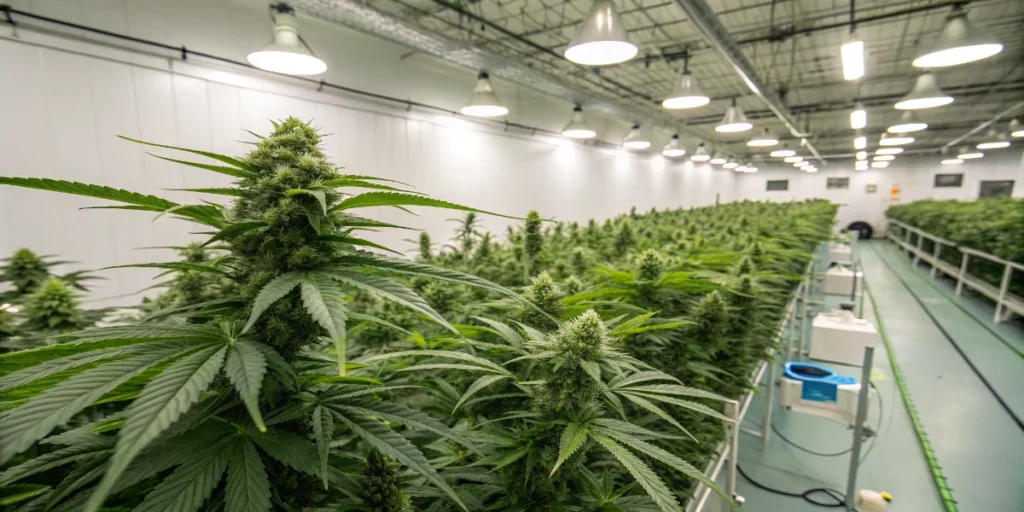
Harvesting, moving and trimming dried plant material can generate airborne dust and biological particles. A workplace study at an outdoor cannabis farm detected bacteria and fungi in worker and area air samples during harvesting, bud stripping and hand trimming, including substantial representation of Botrytis cinerea.
That makes ventilation and general environmental cleanliness relevant to contamination management.
However, an article should not imply that simply installing a HEPA filter guarantees contaminant-free cannabis. Air filtration is only one part of environmental control and must be matched to room design, air exchange, equipment maintenance and the particular operation.
Regulated production guidance similarly treats filtration and ventilation as part of a wider system designed to provide suitable air quality and prevent contamination.
Moisture, Drying and Mold Risk
Poor moisture management can increase microbial risk considerably during post-harvest processing.
Research on cannabis has linked higher temperature and relative humidity within the inflorescence microclimate, inadequate drying and certain drying practices with greater total yeast and mold levels. The same work demonstrated that post-harvest handling and drying method can materially influence the microbial condition of the finished flower.
The current page converts this into a universal rule that cannabis must be kept specifically at 58–62% RH and around 68°F to prevent microbial contamination. I would remove that.
Room relative humidity is not the same measurement as moisture within a dense cannabis flower, and one universal room number cannot represent every processing stage.
A better approach is to establish and validate drying and storage conditions that reliably bring the product to a stable state while preventing persistent high-moisture microenvironments.
Wet Trimming vs Dry Trimming and Contamination
It is tempting to declare one trimming method universally safer, but the evidence is more nuanced.
Cannabis studies have shown that drying method and handling influence yeast and mold levels, and a review of pathogen-management research noted that hang drying followed by trimming after the inflorescences were dry could help reduce microbial loads under the conditions studied.
That does not establish that every dry-trimmed crop is cleaner than every wet-trimmed crop.
Actual contamination risk depends on starting material, drying conditions, processing time, worker practices, equipment cleanliness and the environmental conditions surrounding both methods.
Facilities should therefore validate the process they actually use rather than relying solely on the label “wet trim” or “dry trim.”
Chemical and Physical Cross-Contamination
Microbes are not the only issue.
Cleaning chemicals, lubricants, pesticide residues, foreign material and allergens can also move into cannabis through poorly controlled equipment or processing areas.
A sanitation process can itself become a contamination source if cleaners are used incorrectly or residues remain on cannabis-contact surfaces. Likewise, lubricants or damaged machine parts can introduce unwanted substances if equipment is not maintained appropriately.
Health Canada’s production guidance specifically addresses cleaning agents, lubricants, foreign material and allergen cross-contamination and requires processing equipment to be arranged and maintained so that it does not contaminate cannabis.
This broader definition makes the page considerably stronger because cross-contamination is not synonymous with mold.
Separate Waste From Clean Cannabis
Trimming naturally produces leaves, stems, rejected flowers, dust and other waste.
That material should not circulate repeatedly through clean processing routes.
Waste containers can become contamination reservoirs, while employees carrying waste may touch doors, carts or other equipment before returning to product-handling activities.
A well-designed workflow separates contaminated or discarded material from clean product and clean equipment. Health Canada’s guidance specifically recommends separating waste and contaminated material from production and storage areas and controlling the equipment and routes used to remove it.
This is another reason facility layout matters as much as individual cleaning products.
How to Know Whether a Sanitation Program Is Working
A written cleaning procedure is only useful if it works in practice.
Facilities can verify sanitation through documented inspections, environmental monitoring, surface sampling where appropriate and finished-product microbial testing.
Health Canada’s cannabis production guidance specifically describes verification activities such as reviewing cleaning records and sampling equipment to confirm sanitation effectiveness.
Product testing provides another layer of control, although microbial requirements and analytical methods differ between regulatory systems. Research into U.S. cannabis microbiology testing has documented significant state-to-state variation in target organisms and validation requirements.
Testing therefore complements hygiene rather than replacing it.
A facility should not wait for a failed finished-product result before deciding whether its trimming equipment is being cleaned effectively.
What to Do If Mold Is Found During Trimming
Visible mold should trigger a controlled response rather than simply cutting away the most obvious affected flower and continuing normally.
The potentially affected material should be segregated so it cannot contact clean product, and tools, surfaces or containers that have contacted it should be handled according to the facility’s sanitation procedure.
The operation should also investigate where the problem originated. Contamination may have developed before harvest, during drying or during storage rather than at the trimming table itself.
Research repeatedly shows that cannabis microbial load reflects interactions between the original plant material, cultivation environment and post-harvest handling.
That is why contamination control should focus on tracing the process rather than automatically blaming the last employee who touched the flower.
Cross-Contamination in Cannabis Handling: Key Takeaway
Cross-contamination during cannabis trimming and handling is primarily a process-control problem.
Microorganisms and other contaminants can move through hands, gloves, trimming tools, machinery, tables, containers, air, waste streams and poorly separated batches. Research confirms that harvesting and post-harvest handling practices can influence microbial loads on cannabis flower.
The most effective prevention strategy is therefore not a single humidity number, a particular glove or one disinfectant.
It is a system built around worker hygiene, cleanable equipment, validated cleaning and sanitation procedures, separation of clean and contaminated activities, appropriate drying and environmental control, and verification that those controls are actually working.
FAQs About Cannabis Cross-Contamination
Should you wear gloves when trimming cannabis?
Gloves can reduce direct contact between hands and cannabis, but they only work when used correctly. Dirty gloves can transfer contaminants just as hands can. Workers should clean their hands and change gloves whenever they touch potentially contaminated surfaces, waste or other materials that could transfer contamination back to cannabis.
What are the main risks of cross-contamination in cannabis?
Cross-contamination can transfer molds, bacteria, cleaning residues, chemical contaminants, foreign material or allergens between cannabis, workers, surfaces and equipment. Post-harvest studies show that handling and processing practices can influence microbial loads, making hygiene and process separation important parts of cannabis quality control.
What contaminants are commonly found on cannabis?
Cannabis can carry numerous fungi and bacteria. Research has identified fungal genera including Aspergillus, Penicillium, Cladosporium and Fusarium on cannabis flowers. Regulatory microbial testing may also target particular organisms such as Salmonella, Shiga toxin-producing E. coli and selected Aspergillus species, depending on jurisdiction.
What are five examples of cross-contamination during cannabis processing?
Examples include using trimming tools on another batch without adequate cleaning, handling clean flower after touching waste, returning contaminated gloves to product handling, storing sanitized equipment beside dirty equipment and moving mold-affected cannabis through the same processing area as clean material. Each example involves transferring contamination rather than contamination simply originating in the plant.
Can trimming equipment spread mold between cannabis batches?
Yes, contaminated contact surfaces or retained plant material can provide a pathway for microorganisms to move between batches. Research has also found increased frequency of certain Penicillium species after mechanical trimming. Effective equipment cleaning between relevant production runs and preventing recontamination of cleaned equipment are therefore important controls.
Does 58–62% humidity prevent cannabis mold?
No single room-relative-humidity range guarantees mold prevention. Microbial risk depends on flower moisture, inflorescence microclimate, drying effectiveness, temperature, handling and storage conditions. Cannabis research shows that inadequate drying and higher humidity around inflorescences can increase yeast and mold levels, but that evidence should not be reduced to one universal RH target.