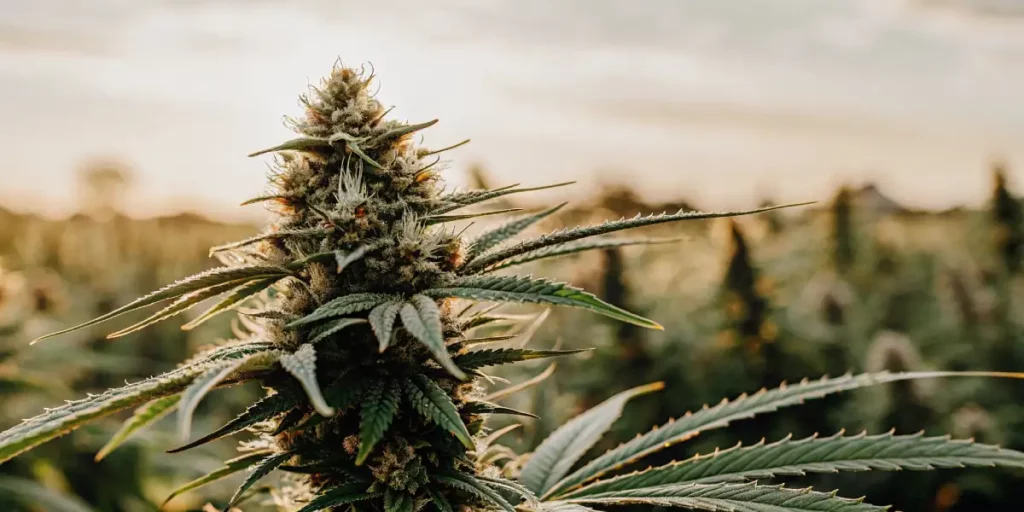

White weed strains are cannabis cultivars known for pale, frost-covered buds or for genetics connected to famous “White” lineages such as White Widow and The White. The white appearance usually comes from dense glandular trichomes, which produce and store cannabinoids and terpenes. However, frostiness alone does not prove a strain has higher THC or predict its effects.
Best White Weed Strains at a Glance
| Strain | Why It Belongs Here | Genetic Connection |
|---|---|---|
| White Widow | Classic resin-heavy White strain | Brazilian × South Indian |
| White Rhino | Early White Widow descendant | White Widow × Afghan genetics |
| The White | Exceptionally frosty Florida cultivar | Distinct from White Widow family |
| White Fire OG | Combines The White with Fire OG | Fire OG × The White |
| White Tahoe Cookies | Modern The White descendant | The White × Tahoe OG/GSC family |
| Crystal White Kush | Combines White Widow with Kush genetics | OG Kush/White Widow × Bubba Kush |
These strains do not all belong to one biological category.
Recommended Strains
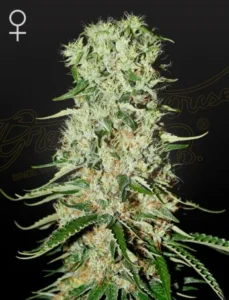
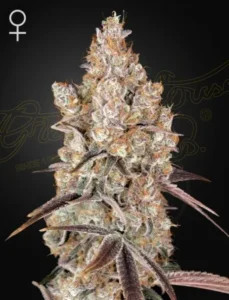
Damnesia

|
THC | 22% - 23% (Medium) |

|
Lineage | A.M.S. x Amnesia Haze |

|
Type | Feminized |

|
Height | 6.07 ft | 1.85 m |

|
Yield Outdoor | 35.27 oz/plant | 1000 g/plant |

|
Flowering Time | 9 - 10 weeks |

|
Phenotype | 40% Indica / 60% Sativa |

|
Effects | Focused, Creative, Talkative, Hungry |

|
Flavors | Woody, Fruity, Incense, Pepper |
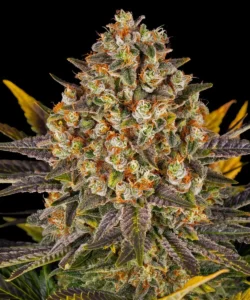
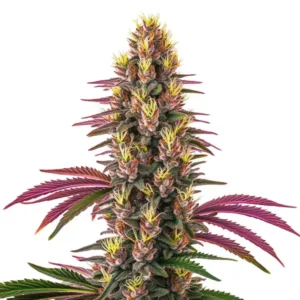
Banana Punch
|
|
THC | 26% - 27% (High) |
|
|
Lineage | Banana OG x Purple Punch |
|
|
Type | Feminized |
|
|
Height | 5.74 ft | 1.75 m |
|
|
Yield Outdoor | 52.91 oz/plant | 1500 g/plant |
|
|
Flowering Time | 8 - 9 weeks |
|
|
Phenotype | 55% Indica / 45% Sativa |
|
|
Effects | Creative, Euphoric, Relaxed |
|
|
Flavors | Earthy, Sweet, Banana, Tropical |
Some are genetically related.
Others simply earned a “White” name because of their heavy resin production or ancestry.
What Are White Weed Strains?
“White weed strains” is an informal cannabis category rather than an official botanical classification.
The phrase generally refers to one of two things:
- Cannabis with an unusually frosty appearance, caused by abundant glandular trichomes.
- Cultivars belonging to or descended from famous White genetics, particularly White Widow or The White.
Those meanings overlap, but they are not identical.
For example, White Rhino belongs to the classic White Widow family.
White Fire OG, also called WiFi OG, instead descends from a different cultivar called The White.
Meanwhile, plenty of cannabis strains without “White” anywhere in their names can produce extremely resinous flowers.
Why Does Some Weed Look White?
The white or crystalline appearance comes primarily from glandular trichomes covering the flowers.
Trichomes are tiny secretory structures found at particularly high densities on female cannabis flowers.
They produce and store compounds including:
- Cannabinoids
- Terpenes
- Other secondary metabolites
Under magnification, mature glandular trichomes resemble tiny stalks topped by rounded resin heads.
When thousands cover the surface of a flower, they reflect light and can make the bud look silver, frosted or almost white.
This is the origin of descriptions such as:
- Frosty weed
- White weed
- Crystal-covered buds
- Resinous flower
The appearance is real, but its meaning is often exaggerated.
Does Whiter Weed Mean Higher THC?
Not necessarily.
Trichomes are central to cannabinoid production, so resin-rich flowers are clearly relevant to cannabis chemistry.
But visible frostiness is not a reliable THC test.
Research into cannabis glandular trichomes notes that the relationship between trichome density and total cannabinoid concentration has not been firmly established across cultivars.
Genetics, trichome type, maturity, biosynthetic activity, growing conditions and sampling all matter.
That means two flowers can both look extremely frosty while testing at substantially different THC concentrations.
A laboratory cannabinoid analysis is more informative than appearance alone.
1. White Widow
The classic white weed strain
White Widow is probably the cultivar most strongly associated with the term “white weed.”
Green House Seed Company traces its genetics to:
Brazilian × South Indian
and records White Widow as a major 1990s cultivar, including a first-place Bio High Times Cannabis Cup award in 1995.
The name reflects its famously resin-covered flowers.
White Widow subsequently became an important parent in numerous crosses and helped establish what breeders commonly refer to as the White family.
Modern versions vary substantially between breeders.
That means one breeder’s White Widow should not automatically be assumed to have the same THC percentage, phenotype or exact characteristics as every other product carrying the name.
For this reason, compare the specific genetics rather than relying solely on the famous name.
2. White Rhino
Classic White-family descendant
White Rhino is another major old-school White cultivar.
Green House Seed Company describes its genetics as:
Afghan × Brazilian × South Indian
and identifies it as a breeding project involving White Widow and selected Afghan genetics.
This makes White Rhino genuinely relevant to a discussion of the White family rather than simply a strain whose name happens to contain “White.”
Like White Widow, it is known for flowers with extensive glandular trichome coverage.
The Afghan contribution also differentiates its plant structure and genetic composition from the original White Widow.
White Rhino is a useful example of how breeders expanded the White family by crossing resinous White Widow genetics with other established lines.
3. The White
Best example of a separate White lineage
The White is important because it clears up a common misconception:
Not every famous White strain descends from White Widow.
The White is generally associated with Florida and was reportedly known earlier as Triangle.
Its exact ancestry remains uncertain.
What made the cultivar famous was its extreme trichome coverage, with flowers capable of appearing almost coated in pale crystals.
That visual characteristic explains the name.
The White later became influential as a breeding parent, giving rise to cultivars such as White Fire OG.
So there are effectively multiple important “White” families in cannabis breeding rather than one single White lineage.
4. White Fire OG
Best-known The White × OG cross
White Fire OG is usually shortened to WiFi OG.
Its lineage is:
Fire OG × The White
Growlantis currently lists its WiFi OG genetics in that form.
The cultivar combines the heavy trichome reputation of The White with OG-family genetics.
That makes White Fire OG especially useful for understanding the difference between the two major uses of “White” in cannabis naming.
It is not simply another White Widow phenotype.
Its White ancestry comes through The White.
Modern commercial versions can also vary considerably in reported cannabinoid levels, so the name should be treated as genetic context rather than a guarantee of exact potency.
5. White Tahoe Cookies
Modern The White descendant
White Tahoe Cookies demonstrates how White genetics continued into newer hybrid families.
Growlantis lists its White Tahoe Cookies Autoflower lineage as involving:
The White × Tahoe OG × Girl Scout Cookies-derived genetics, together with Ruderalis for the autoflowering trait.
The result connects The White to two other influential modern cannabis families.
Its inclusion is useful because “white weed strains” should not be limited entirely to 1990s cultivars.
Modern breeding continues to use resin-producing White ancestry to create new combinations.
Again, however, having The White somewhere in the family tree does not mean every descendant will have identical chemistry or effects.
6. Crystal White Kush
White Widow meets Kush genetics
Crystal White Kush provides an example from the other major White branch.
Growlantis lists its lineage as:
(OG Kush × White Widow) × Bubba Kush
That means White Widow rather than The White provides the White-family component.
This makes Crystal White Kush a useful counterpart to White Fire OG.
Both combine White-associated genetics with Kush lines, but their actual ancestry is different.
This is why researching lineage is more informative than grouping every cannabis cultivar containing “White” into one family.
White Widow vs The White: Are They the Same?
No.
This is one of the most useful distinctions the article can make.
White Widow
Has documented Brazilian and South Indian ancestry and became one of the best-known Dutch cannabis cultivars of the 1990s.
The White
Is a separate cultivar associated with Florida whose earlier history is much less certain.
Both became famous for very resinous flowers.
Both contributed genetics to later cultivars.
But The White is not another name for White Widow.
That distinction explains why strains such as White Rhino and White Fire OG belong to different genetic branches despite sharing similar naming.
Are All White Weed Strains Related?
No.
Cannabis naming is not a scientific taxonomy.
A strain may contain “White” in its name because:
- It descends from White Widow.
- It descends from The White.
- It produces unusually frosty flowers.
- A breeder chose the name for marketing or visual reasons.
Therefore, you cannot infer lineage from the word White alone.
The same problem applies more broadly to cannabis strain names.
Genetic research has repeatedly demonstrated that commercial cultivar names do not always correspond consistently with genetic identity.
When ancestry matters, breeder provenance and documented lineage are more useful than the name itself.
Are White Weed Strains Always High THC?
No.
There is no biological rule requiring a White strain to contain high THC.
Different White Widow versions alone can vary considerably.
Growlantis currently lists examples ranging from more moderate autoflowering White Widow genetics to White Widow XXL products with much higher reported THC.
That variation demonstrates the problem with treating a family name as a potency category.
THC depends on:
- Genetics
- Individual phenotype
- Cultivation
- Harvest timing
- Post-harvest handling
- Laboratory sampling and analysis
“White” tells you something about heritage or appearance.
It does not give you a laboratory cannabinoid result.
Are White Weed Strains Indica or Sativa?
They can be either, or more commonly hybrids.
White Widow is widely treated as a hybrid.
White Rhino incorporates substantial Afghan ancestry.
White Fire OG combines The White and Fire OG.
White Tahoe Cookies adds multiple modern hybrid families.
There is therefore no single indica/sativa classification for white weed strains.
More importantly, indica and sativa labels themselves are imperfect predictors of a cannabis product’s genetic identity or effects.
Look at documented lineage and cannabinoid information rather than expecting the word White to correspond with one effect category.
Are White Strains Better for Sleep or Pain?
There is no scientific basis for saying that White strains as a category are specifically better for sleep, pain, anxiety or another medical condition.
Individual cannabis products can contain substantially different amounts of THC, CBD and other compounds.
People can also respond differently to the same product.
Claims such as:
“White weed strains are ideal for pain relief”
or
“White Rhino is the best strain for insomnia”
go beyond what a strain name can establish.
Anyone considering cannabis for a medical symptom should focus on evidence appropriate to that condition rather than selecting a product because it belongs to the White family.
What Makes a Good White Weed Strain?
If you are comparing White-family genetics, focus on more than frostiness.
Documented Lineage
Determine whether the cultivar descends from White Widow, The White or another line entirely.
Cannabinoid Profile
Look at actual THC and CBD information rather than assuming a resinous appearance means extreme potency.
Breeder Provenance
The same strain name can represent different genetics from different breeders.
Cultivation Characteristics
Compare flowering type, plant structure, environmental requirements and expected growth pattern if cultivation is the objective.
Terpene and Aroma Information
White-family cultivars can have very different aromatic profiles.
There is no universal “White strain flavor.”
Growing White Weed Strains
There is no special cultivation system required simply because a cultivar contains “White” in its name.
The plants should be managed according to their specific genetics and environment.
White Widow, White Rhino and White Fire OG are genetically different plants and should not automatically receive identical nutrient, humidity or training schedules.
One thing they often share is interest in resin production.
Protecting developing trichomes from physical damage and maintaining an appropriate flowering environment can help preserve flower quality.
But additional nutrients do not automatically create more THC, and White strains do not inherently require extra calcium or magnesium because they are resinous.
Follow plant response and cultivar-specific guidance rather than a generic “White strain” feeding program.
Do Milky Trichomes Mean THC Is at Its Peak?
Not with enough precision to make that a universal rule.
Trichome appearance changes as flowers mature, and growers often examine clear, cloudy and amber trichomes when estimating harvest maturity.
Recent research has found relationships between visual trichome maturity and cannabinoid concentrations, but those relationships vary between cultivars and are not perfectly synchronized.
Trichome color can therefore provide useful maturity information.
It should not be interpreted as a direct laboratory measurement of THC.
White Weed Strains: Key Takeaway
White weed strains are best understood as resinous cannabis cultivars and genetic families rather than one scientifically defined category.
White Widow helped establish the classic Dutch White family, including descendants such as White Rhino.
The White represents a separate influential lineage that later contributed to strains such as White Fire OG and White Tahoe Cookies.
Their characteristic frosty appearance comes from glandular trichomes.
Those trichomes are where cannabis produces and stores many cannabinoids and terpenes, but greater visible frost does not automatically equal greater THC.
When comparing white weed strains, prioritize lineage, cannabinoid analysis and breeder provenance rather than assuming the name or appearance predicts potency, effects or medical benefits.
FAQs About White Weed Strains
What are white weed strains?
White weed strains are cannabis cultivars known for heavy trichome coverage or genetics connected to famous White-family cultivars. White Widow, White Rhino, The White and White Fire OG are prominent examples. The term is informal rather than botanical, and strains containing “White” in their names are not necessarily genetically related to one another.
Why does some cannabis look white?
Cannabis flowers can look white or frosty when their surfaces are densely covered with glandular trichomes. These microscopic structures produce and store cannabinoids, terpenes and other metabolites. Light reflecting from large numbers of resin glands creates the crystalline appearance, although visible trichome coverage alone cannot determine the flower’s exact THC concentration.
What is the most famous white weed strain?
White Widow is arguably the most famous classic White strain. Green House Seed Company traces the cultivar to Brazilian and South Indian genetics and records its success in the 1990s cannabis competition scene. Its resin-covered flowers and extensive use in later breeding helped establish an entire family of White Widow-derived cultivars.
Is white weed stronger than green weed?
Not necessarily. White-looking cannabis often has extensive trichome coverage, but research has not established a simple universal relationship between visible trichome density and total cannabinoid concentration. Green-looking flower can test higher in THC than extremely frosty flower. Reliable potency information requires chemical testing rather than comparing color or visible crystals alone.
Are White Widow and The White the same strain?
No. White Widow is a documented Brazilian × South Indian cultivar associated with Dutch breeding in the 1990s. The White is a separate cultivar associated with Florida and reportedly known earlier as Triangle. Both became famous for heavy resin production, but they represent distinct genetic histories and produced different descendant families.
Are white weed strains good for beginners?
The word White does not indicate whether a cultivar is suitable for a beginner. White-family strains can vary substantially in THC concentration, plant growth and effects. Someone comparing cannabis products should check actual cannabinoid information, while growers should compare flowering type, plant structure and cultivation requirements rather than assuming all White strains behave similarly.