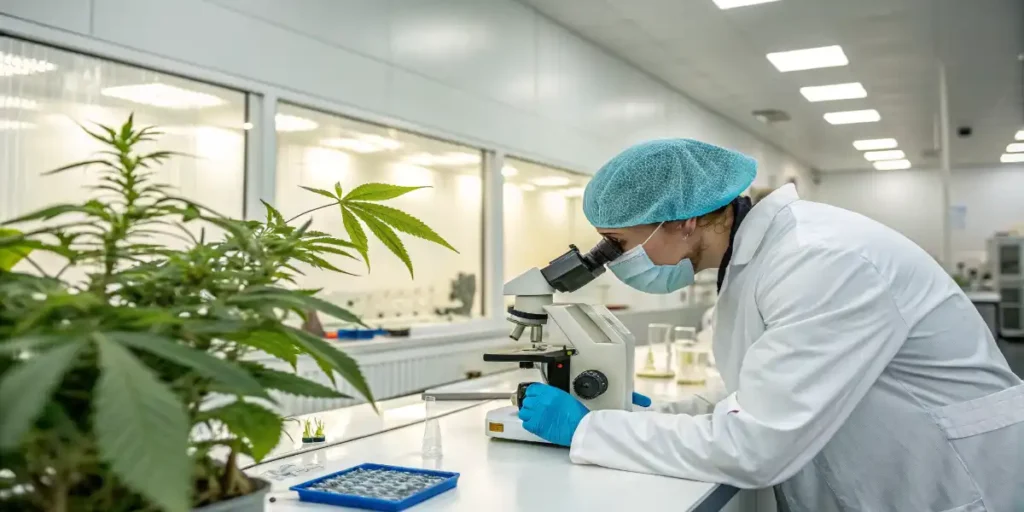

A refractometer and plant sap analysis measure different things in cannabis. A refractometer provides a fast Brix reading based on the refractive index of expressed plant juice, while sap analysis can quantify specific nutrients and other parameters in plant sap. Brix is useful for tracking trends, but it cannot diagnose nutrient deficiencies or predict cannabis yield, THC or plant health by itself.
Refractometer vs Sap Analysis at a Glance
| Feature | Refractometer / Brix | Plant Sap Analysis |
|---|---|---|
| Main measurement | Refractive index, reported as °Brix | Specific nutrients or other measured compounds |
| Result speed | Immediate | Immediate with some field meters; longer with laboratories |
| Typical cost | Relatively low | Higher, especially laboratory testing |
| Nutrient-specific? | No | Yes, depending on test |
| Shows total plant nutrition? | No | No |
| Identifies a specific deficiency? | No | Potentially, with validated interpretation |
| Predicts THC or yield? | No validated relationship | No direct prediction |
| Best use | Consistent trend monitoring | More detailed nutrient diagnostics |
The two tools are therefore better understood as different levels of measurement, not competing versions of the same test.
Recommended Strains
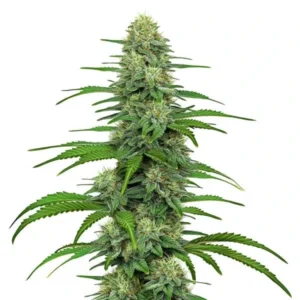
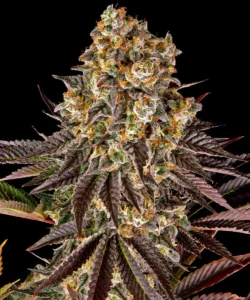
GG4

|
THC | 27% (High) |

|
Lineage | Chem Sis x Sour Dubb x Diesel Chocolate |

|
Type | Feminized |

|
Height | 6.56 ft | 2 m |

|
Yield | High |

|
Yield Indoor | 1.64 - 1.97 oz/ft² | 500 - 600 g/m² |

|
Yield Outdoor | 24.69 - 28.22 oz/plant | 700 - 800 g/plant |

|
Flowering Time | 8 - 10 weeks |

|
Phenotype | 40% Indica / 60% Sativa |

|
Medical | Anxiety, Depression, Pain |

|
Effects | Happy, Relaxed, Talkative |

|
Flavors | Fruity, Pine, Spicy |
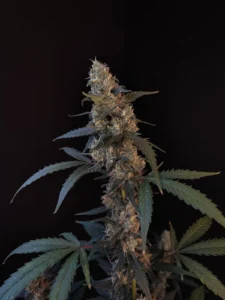
Runtz Auto
|
|
THC | 26% - 27% (High) |
|
|
Lineage | Gelato x Zkittlez x Ruderalis |
|
|
Type | Autoflowering |
|
|
Height | 7.05 ft | 2.15 m |
|
|
Yield | High |
|
|
Yield Indoor | 1.47 - 1.64 oz/ft² | 450 - 500 g/m² |
|
|
Yield Outdoor | 3.53 - 5.29 oz/plant | 100 - 150 g/plant |
|
|
Life Cycle | 8 - 9 weeks |
|
|
Phenotype | 50% Indica / 50% Sativa |
|
|
Effects | Balanced |
|
|
Flavors | Earthy, Floral, Sweet |
What Does a Refractometer Measure?
A refractometer measures how much light bends when it passes through a liquid.
The result is commonly displayed in degrees Brix (°Bx). The Brix scale was developed around sucrose solutions, so a reading of 10°Bx corresponds to the refractive index expected from a solution containing roughly 10% sucrose by mass under standardized conditions.
Plant sap is not a pure sugar solution.
It contains sugars alongside minerals, organic acids, amino acids and other dissolved compounds. A refractometer therefore responds to total soluble material affecting refractive index, not exclusively to sugar.
That is an important distinction for cannabis growers.
A 12°Bx reading should not be interpreted as “this cannabis leaf contains exactly 12% sugar,” nor as a direct measurement of photosynthesis, nutrient status or cannabinoid production.
What Is Brix Used for in Cannabis Cultivation?
The most defensible use is comparative trend monitoring.
For example, a grower could repeatedly measure comparable leaves from the same cultivar and track whether readings rise, fall or remain stable over time.
That may help identify an unusual change worth investigating.
But Brix alone cannot tell you why the reading changed.
Possible influences include plant water status, time of sampling, developmental stage, leaf position and the concentrations of multiple dissolved substances.
That means a declining Brix reading is not automatically an instruction to increase fertilizer.
The current article suggests that a Brix decline could indicate a need for additional nutrients or environmental adjustment. In practice, a refractometer does not provide enough information to diagnose that cause independently.
Does Higher Brix Mean Healthier Cannabis?
Not necessarily.
This is one of the biggest misconceptions surrounding refractometers.
A higher reading tells you that the sampled liquid has a higher refractive index. It does not establish that the plant is healthier.
To make that conclusion, researchers would need validated cannabis-specific relationships linking a defined sampling protocol and Brix range with measurable crop-health outcomes.
There is currently no established universal cannabis Brix threshold at which a plant becomes “healthy,” nor a validated rule that higher Brix always means better performance.
The number becomes much more useful when treated as one repeated measurement within the same crop, rather than a universal score.
Does High Brix Mean Higher THC or Yield?
There is no established evidence that a particular cannabis Brix reading predicts THC concentration, terpene concentration or final flower yield.
Commercial cannabis discussions sometimes propose these relationships, but even cannabis-industry laboratories describe the connection between Brix and traits such as cannabinoid or terpene production as an area requiring further study rather than an established predictive model.
So statements such as:
“Higher Brix means more potent buds”
or
“Raise Brix to maximize yield”
should not be presented as established cannabis science.
Brix can be data.
It is not a potency meter.
How to Use a Refractometer More Consistently
A refractometer only becomes useful for comparison when sampling is reasonably standardized.
Try to keep variables such as:
- cultivar
- leaf age and position
- developmental stage
- sampling time
- irrigation timing
- sampling method
- instrument calibration
as consistent as possible.
This matters because plant chemistry changes spatially and temporally.
The same principle also applies to professional plant sap analysis. A 2026 controlled-environment study emphasized that sap diagnostics require standardized sampling involving factors such as leaf age, developmental stage and time of day because results can otherwise vary substantially.
Before measuring, calibrate the refractometer according to its manufacturer’s instructions.
Then use the reading primarily to compare like with like.
What Is Plant Sap Analysis?
Plant sap analysis goes much further than a Brix reading.
Instead of measuring one physical property of the liquid, sap testing can quantify individual nutrient ions or other chemical parameters.
Depending on the laboratory or instrument, the panel may include nutrients such as:
- nitrate nitrogen
- potassium
- calcium
- magnesium
- phosphorus
- sulfur
- iron
- manganese
- zinc
- boron
Some services also report parameters such as pH, electrical conductivity or forms of nitrogen.
The exact panel varies considerably between laboratories.
Plant sap analysis is therefore not one standardized test.
It is a category of analytical approaches.
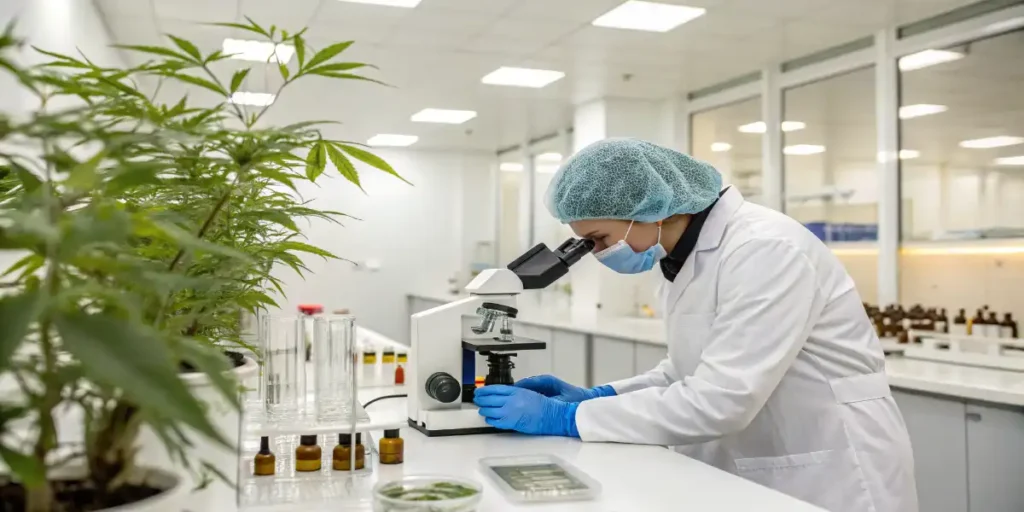
What Can Sap Analysis Tell a Cannabis Grower?
Its main advantage is nutrient specificity.
Suppose a grower sees an unexpected change in plant performance.
A Brix reading cannot tell them whether nitrate, potassium or calcium is unusual.
A sap analysis potentially can.
The approach is attractive because sap represents nutrients and metabolites currently moving through plant tissues rather than only the total elemental content accumulated in dried leaves.
A 2025 review of plant sap analysis in controlled-environment agriculture describes it as a potential real-time nutrient-management tool, particularly for monitoring actively transported nutrients.
That makes it potentially valuable for precision fertigation.
But there are important limitations.
Sap Analysis Is Not the Same as Tissue Analysis
Traditional laboratory tissue analysis and plant sap analysis answer related but different questions.
Tissue analysis measures nutrients accumulated within plant material.
Sap analysis focuses more strongly on soluble or transported nutrient forms present at sampling.
Neither automatically makes the other obsolete.
A major 2026 Scientific Reports study compared multiple sap extraction methods against conventional nutrient leaf analysis in tomato, cucumber and lettuce. Relationships ranged from strong for certain nutrient-crop combinations to weak or even negative for others. The researchers concluded that none of the evaluated sap methods could universally replace leaf nutrient analysis.
That study was not conducted on cannabis, which makes another point especially important:
diagnostic relationships need crop-specific validation.
Is Cannabis Sap Analysis Scientifically Validated?
Sap analysis is already being used commercially in cannabis production, and laboratories offer cannabis-specific testing and sampling protocols.
However, commercial availability should not be confused with a universally standardized scientific interpretation system.
The broader plant-science literature continues to identify limitations involving:
- extraction method
- sampled tissue
- plant age
- time of sampling
- crop species
- nutrient measured
- environmental conditions
A 2026 comparison found weak-to-moderate relationships between sap methods and standard tissue analysis overall, with performance differing substantially by crop and nutrient.
So a cannabis sap result is most useful when interpreted using a validated laboratory protocol, consistent sampling and appropriate crop-specific reference data.
Refractometer vs Sap Analysis: Which Is More Accurate?
That question does not quite work because they are measuring different things.
A calibrated refractometer can accurately measure refractive index.
That does not mean it accurately measures potassium, nitrogen or general plant health—because those are not the quantities it was designed to measure.
Likewise, a laboratory sap analysis may accurately quantify a nutrient concentration but still require careful interpretation before translating that concentration into a fertilizer change.
Accuracy therefore has two levels:
Analytical accuracy: Did the instrument measure the intended variable correctly?
Diagnostic accuracy: Does that result correctly tell you what is happening agronomically?
The second question is much harder.
Refractometer vs Sap Analysis for Detecting Nutrient Problems
For a specific nutrient diagnosis, sap analysis has the obvious advantage.
A refractometer cannot distinguish between nitrogen deficiency, potassium imbalance, root-zone stress or a change in plant water status.
It gives only a refractive-index measurement.
Sap analysis can measure individual nutrient ions.
Portable ion-selective electrodes have also shown useful accuracy for measuring nitrate in petiole sap in several greenhouse vegetable crops, demonstrating that rapid sap-based nutrient measurement can work when the specific crop, analyte and method are adequately validated.
That does not mean every handheld sap meter works equally well for cannabis.
The methodology still matters.
Can a Refractometer Tell You When to Feed Cannabis?
Not by itself.
If Brix changes unexpectedly, the reading can provide a reason to investigate.
But it should not automatically trigger more fertilizer.
A better diagnostic sequence might involve checking:
- root-zone EC
- root-zone pH
- irrigation behavior
- environmental conditions
- leaf symptoms
- nutrient solution
- runoff or drainage
- tissue or sap analysis when justified
This is much safer than treating “low Brix” as synonymous with “hungry plant.”
Increasing fertilizer in response to an ambiguous Brix number could make an existing nutrient excess worse.
Can Sap Analysis Tell You Exactly How Much Fertilizer to Add?
Not automatically.
A laboratory result can identify unusually low or high measured nutrient concentrations relative to its reference framework.
Turning that result into a fertigation change still requires context.
For example, a low concentration in plant sap could relate to root-zone availability, nutrient antagonism, water uptake, transpiration, environmental conditions, developmental demand or sampling variability.
The result should therefore be interpreted alongside the cultivation system.
Even commercial cannabis sap-analysis providers recommend pairing sap information with root-zone, nutrient-solution or leachate testing rather than using sap data completely in isolation.
Refractometer vs Sap Analysis: Cost and Convenience
A refractometer wins easily on convenience.
A basic handheld unit provides an immediate measurement and can be used repeatedly without laboratory fees.
That makes it suitable for growers interested in tracking trends.
Sap analysis becomes more expensive and operationally demanding.
Laboratory testing requires correct sampling, packaging and processing, while portable nutrient meters require separate sensors, maintenance, calibration and an interpretation framework.
The extra complexity provides more specific information.
So the choice is essentially:
Refractometer = low-cost trend measurement
Sap analysis = more expensive, nutrient-specific diagnostic information
Should You Use Both?
Potentially, but not because combining them creates a magical “complete picture” of cannabis health.
Their usefulness depends on the question you are trying to answer.
A grower interested in monitoring a repeatable plant-sap trend may use Brix routinely and reserve laboratory testing for defined diagnostic questions.
Another grower managing a high-value controlled-environment crop may prefer regular nutrient sap analysis alongside root-zone measurements.
The 2026 research on sap diagnostics supports this broader philosophy: sap information can be useful, but it works best as one component of a larger diagnostic framework rather than as a universal replacement for established methods.
When a Refractometer Makes More Sense
Choose a refractometer when you want:
- an immediate reading
- inexpensive repeat measurements
- a comparative trend over time
- a simple field measurement
- no laboratory turnaround
Do not choose one because you expect it to directly measure:
- nitrogen
- potassium
- calcium
- THC
- terpene concentration
- disease resistance
- final yield
It measures refractive index.
Everything beyond that requires interpretation and evidence.
When Sap Analysis Makes More Sense
Choose sap analysis when you need information about specific nutrients and have access to an appropriate analytical and interpretation framework.
It can be especially valuable when the question is:
“What nutrient is moving through the plant at an unusual concentration?”
rather than:
“Has my general Brix trend changed?”
Professional testing is particularly attractive in controlled environments where growers already collect root-zone EC, pH, irrigation, environmental and nutrient-solution data.
The sap result can then be interpreted alongside those measurements instead of becoming a standalone number.
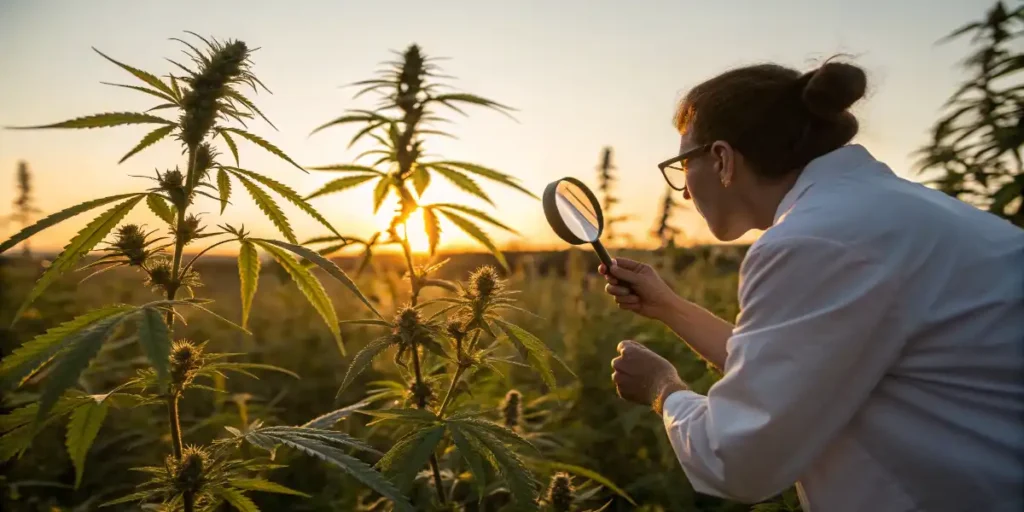
Refractometer vs Sap Analysis: Key Takeaway
A refractometer and plant sap analysis should not be treated as interchangeable cannabis diagnostic tools.
A refractometer measures refractive index, commonly expressed as Brix. It is fast, inexpensive and useful for consistent trend monitoring, but it does not identify individual nutrients and does not provide a validated prediction of cannabis yield, THC or overall plant health.
Sap analysis measures defined chemical components of extracted plant sap. It can provide much more specific nutrient information, but results depend heavily on sampling, analytical method, crop and interpretation.
Recent controlled-environment research shows that sap analysis can be useful while also demonstrating that it does not universally correspond with conventional leaf nutrient analysis.
For cannabis cultivation, the most defensible approach is therefore not to ask which tool is universally “better.”
Ask instead:
What variable am I trying to measure?
If you want a quick comparative Brix trend, use a refractometer.
If you need nutrient-specific diagnostic information, use an appropriately validated sap-analysis method.
And in either case, avoid turning a single measurement into claims about potency, yield or plant health that the measurement itself cannot support.
FAQs About Refractometers and Sap Analysis
What is the difference between a refractometer and sap analysis?
A refractometer measures the refractive index of expressed plant juice and normally reports the result as °Brix. Sap analysis can quantify individual nutrients and other chemical parameters. A refractometer therefore provides one rapid comparative measurement, while sap testing can provide much more nutrient-specific information depending on the analytical method used.
Does Brix measure sugar in cannabis plants?
Not exclusively. A refractometer’s Brix scale is calibrated against sucrose solutions, but cannabis sap contains many dissolved compounds besides sugar. Minerals, organic acids and other solutes can contribute to refractive index. Brix is therefore better described as a refractometric reading of soluble material than as an exact measurement of cannabis sugar concentration.
What is a good Brix level for cannabis?
There is no scientifically established universal Brix target that defines healthy, high-yielding or high-potency cannabis. Readings are more useful when the same cultivar, tissue and sampling conditions are measured consistently over time. Treat Brix as comparative data rather than a universal cannabis health score.
Does high Brix mean higher THC?
No validated cannabis relationship establishes that a higher leaf-sap Brix reading reliably predicts higher THC. Cannabis-industry discussions have proposed possible relationships between Brix and crop quality, but these remain areas for investigation rather than established potency equations.
Is plant sap analysis better than tissue analysis?
Not universally. Sap analysis can provide more immediate information about soluble nutrients, while tissue analysis measures nutrients accumulated in plant material. A 2026 study found that relationships between the two methods varied substantially by crop, nutrient and extraction method, concluding that sap testing could not universally replace leaf nutrient analysis.
How often should cannabis Brix be measured?
There is no validated universal cannabis schedule such as “once per week.” If Brix is being used for trend monitoring, consistency matters more than a particular frequency. Sample comparable tissue at comparable developmental stages and times under standardized conditions so changes are less likely to reflect sampling differences rather than plant changes.