


Sweet ZZ is an indica-dominant feminized photoperiod strain created from Grape Ape and Grapefruit genetics. Bred by Royal Queen Seeds, it is classified as 80% Indica and 20% Sativa, reaches up to 22% THC and flowers in approximately 50–60 days.
If you love sweet, fruity indicas with an easy, forgiving grow, there is a classic worth adding. Our Sweet Tooth seeds deliver a honeyed, candy-sweet flavour and a relaxing, full-bodied effect, producing compact, resin-heavy plants that suit growers who want rich aroma and a mellow, soothing high.
Recommended Strains

Sweet Zz

|
THC | 21% - 22% (Medium) |

|
Lineage | Grape Ape x Grapefruit |

|
Type | Feminized |

|
Height | 5.74 ft | 1.75 m |

|
Yield | High |

|
Yield Indoor | 1.8 - 1.97 oz/ft² | 550 - 600 g/m² |

|
Yield Outdoor | 17.64 - 19.4 oz/plant | 500 - 550 g/plant |

|
Flowering Time | 7 - 9 weeks |

|
Phenotype | 80% Indica / 20% Sativa |

|
Effects | Calming, Relaxed |

|
Flavors | Candy, Citrus, Fruity, Pine |

Sweet Zz Auto
|
|
THC | 17% - 18% (Medium) |
|
|
Lineage | Sweet ZZ x Diesel Auto |
|
|
Type | Autoflowering |
|
|
Height | 3.61 ft | 1.1 m |
|
|
Yield | Medium |
|
|
Yield Indoor | 1.15 - 1.31 oz/ft² | 350 - 400 g/m² |
|
|
Yield Outdoor | 3.17 - 6.17 oz/plant | 90 - 175 g/plant |
|
|
Life Cycle | 6 - 7 weeks |
|
|
Phenotype | 60% Indica / 35% Sativa / 5% Ruderalis |
|
|
Effects | Relaxed |
|
|
Flavors | Candy, Citrus, Fruity, Pine |
Current Sweet ZZ seeds reach approximately 80–140 cm indoors and 160–200 cm outdoors. Indoor yields are listed at 550–600 g/m², while outdoor plants can produce around 500–550 g each and are typically ready for harvest in late September.
| Sweet ZZ Grow Info | Current specification |
|---|---|
| Breeder | Royal Queen Seeds |
| Genetics | Grape Ape × Grapefruit |
| Seed type | Feminized photoperiod |
| Indica / Sativa | 80% Indica / 20% Sativa |
| THC | Up to 22% |
| CBD | Low |
| Flowering time | 50–60 days |
| Indoor height | 80–140 cm |
| Outdoor height | 160–200 cm |
| Indoor yield | 550–600 g/m² |
| Outdoor yield | 500–550 g/plant |
| Outdoor harvest | Late September |
| Climate | Short summers |
| Flavor | Candy, citrus, fruity |
| Effects | Calming, stoned |
Sweet ZZ Genetics
Sweet ZZ combines Grape Ape with Grapefruit. This is the current genetic background published by Royal Queen Seeds and replaces older or inaccurate descriptions that list Zkittlez × Grape Ape as its parentage.
The result is a strongly indica-dominant photoperiod hybrid with an 80% Indica / 20% Sativa classification. Growers interested in other genetics from the same breeder can explore the wider Royal Queen Seeds collection.
Sweet ZZ is photoperiodic. Indoor growers therefore control when flowering begins by changing the day length rather than waiting for the plant to enter bloom automatically at a predetermined age.
Sweet ZZ vs Sweet Zkittlez: Are They the Same?
Sweet ZZ has previously been marketed as Sweet Zkittlez, and older references to that name can still appear in search results, grow discussions and product descriptions. Royal Queen Seeds now uses Sweet ZZ as the current official product name.
Other search variations such as SweetZ, Sweet ZZ strain or Sweet Z may also refer to the same cultivar in informal discussions. For technical grow data, the current Sweet ZZ name and breeder specification should remain the reference.
This naming distinction is particularly important when comparing Sweet ZZ with unrelated Z-named strains or Sweet ZZ Auto, which has a different genetic background and lifecycle.
Is Sweet ZZ Indica or Sativa?
Sweet ZZ is 80% Indica and 20% Sativa, making it clearly indica dominant.
The current breeder classification is more Indica leaning than the 70/30 ratio found in some older descriptions. Its relatively compact indoor size and bushy development are consistent with that classification, although individual phenotype and growing conditions can still influence plant structure.
The breeder describes the effects as calming and stoned. These descriptions should remain separate from the genetic ratio itself, as individual response can vary with dose, tolerance and the chemical composition of a particular harvest.
How Much THC Does Sweet ZZ Have?
Royal Queen Seeds currently lists Sweet ZZ at up to 22% THC.
Older narrative copy may still show lower 15–20% figures, but the breeder’s current structured data sheet uses the higher up-to-22% specification. That is the most appropriate figure for the current seed line.
The wording “up to” matters. A breeder specification describes genetic potential rather than guaranteeing that every harvested flower will measure exactly 22%. Phenotype, light, overall plant health, maturity and post-harvest handling can all influence the cannabinoid concentration of an individual crop.
Sweet ZZ Flavor and Aroma
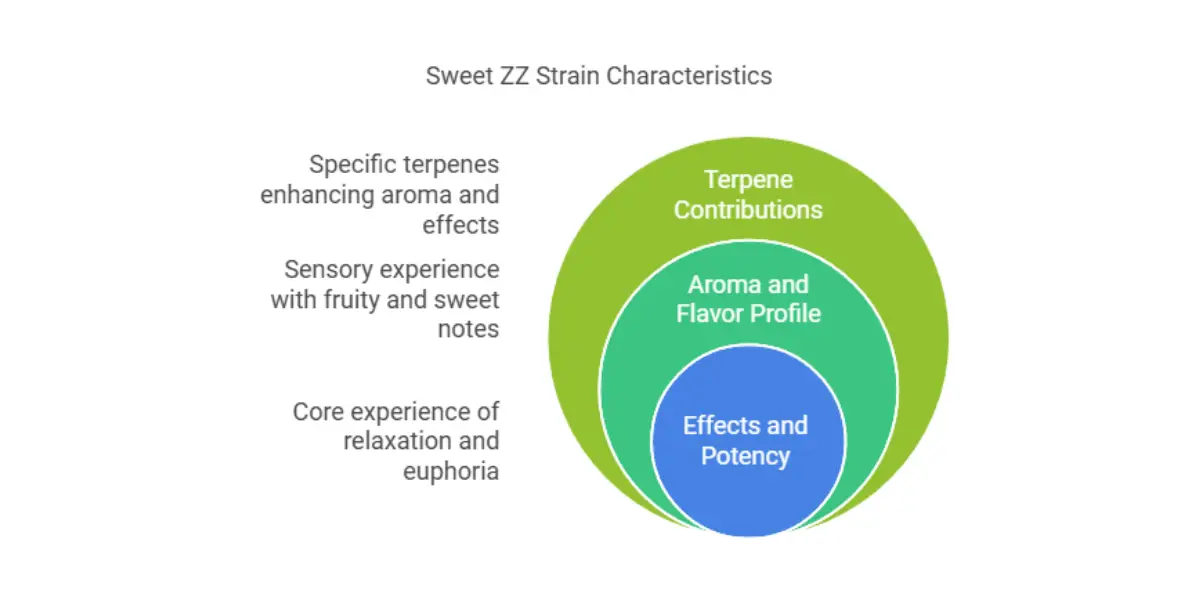
Sweet ZZ is built around a sweet, fruit-forward profile. Royal Queen Seeds currently lists candy, citrus and fruity as its principal flavors, while broader breeder descriptions also emphasize berry, grape and sugary characteristics.
These sensory notes fit the Grape Ape × Grapefruit background particularly well, combining darker fruit characteristics with brighter citrus sweetness.
Some older descriptions assign myrcene, limonene and caryophyllene as dominant terpenes. However, the current technical data sheet does not provide a quantitative terpene profile, so those compounds should not be treated as a definitive hierarchy without additional analytical data for this exact seed line.
Sweet ZZ Flowering Time
Sweet ZZ has a current breeder-listed flowering period of 50–60 days, which equals approximately seven to nine weeks.
This is the flowering phase only. It should not be interpreted as the complete amount of time from germination to harvest because Sweet ZZ is a photoperiod strain and the grower controls the length of vegetative development.
Indoors, plants can remain under a vegetative light schedule until the desired size and canopy have developed. Changing to approximately 12 hours of light and 12 hours of uninterrupted darkness then initiates flowering.
From that transition onward, the 50–60 day range provides the most useful timing reference.
Sweet ZZ Height and Plant Structure
Sweet ZZ reaches approximately 80–140 cm indoors and 160–200 cm outdoors.
That distinction is more useful than describing the plant with one universal 1.75 m height. Indoor growers can further influence size through vegetative duration, container volume and training, while outdoor plants have more space and time to develop.
Royal Queen Seeds describes Sweet ZZ as productive and bushy, with a large central cola supported by smaller flowering sites. Its canopy can therefore become relatively dense despite the manageable indoor height.
Growers working in restricted spaces should plan both vertical and lateral room rather than considering height alone.
Growing Sweet ZZ Indoors
Sweet ZZ is currently listed at 550–600 g/m² indoors under suitable conditions.
Its 80–140 cm indoor height makes it manageable in a range of controlled environments, but the bushy canopy still benefits from planning before flowering begins. Allowing branches to overlap heavily can reduce light distribution and create stagnant internal areas as flowers gain density.
There is no universal number of vegetative weeks required to reach the published yield. A grower with limited space may initiate flowering relatively early, while a larger environment can support additional vegetative development.
Use canopy size and available space to decide when flowering should begin rather than following a fixed week-by-week schedule.
Growing Sweet ZZ Outdoors
Outdoors, Sweet ZZ reaches approximately 160–200 cm and is currently listed at 500–550 g per plant under favorable conditions.
Royal Queen Seeds lists the cultivar for harvest in late September, making it relatively suitable for regions where growers want to finish before later autumn weather becomes established.
Outdoor production still depends heavily on sunlight, root space, plant health and the length of the growing season. The 500–550 g range should therefore be treated as breeder-listed production potential rather than a guaranteed result.
Provide enough spacing for the bushy canopy to develop without excessive overlap and continue monitoring dense flowering sites as harvest approaches.
Sweet ZZ Yield
Current specifications list Sweet ZZ at 550–600 g/m² indoors and 500–550 g per plant outdoors.
Indoor yield is expressed by area because plant count, vegetative duration and training can vary substantially within the same square meter. The aim is to create productive canopy coverage rather than chase one particular weight from each individual plant.
Outdoor production is expressed per plant because the root system and canopy can become substantially larger.
Neither figure guarantees a particular harvest. Lighting, root volume, growing conditions, canopy management and plant health all affect how closely an individual grow approaches the breeder specification.
How to Germinate Sweet ZZ Seeds
Sweet ZZ does not require a unique strain-specific germination technique. Seeds need consistent moisture, suitable warmth and enough oxygen while avoiding prolonged waterlogging.
A damp paper-towel method can be used to observe taproot emergence before transferring the seed into a growing medium. Direct germination in a suitable starting medium is another option and reduces the amount of handling required.
Once a root emerges, handle the seed gently and avoid damaging the developing taproot. Early watering should reflect the small root system rather than the needs of an established plant.
For more detailed environmental guidance, see the cannabis seed germination temperature and humidity guide.
Vegetative Growth
Sweet ZZ is photoperiodic, so vegetative growth does not have a fixed duration.
Indoor growers can keep the plant in vegetation until its root system, branch structure and canopy fit the intended flowering space. This means there is no biological requirement for Sweet ZZ to spend exactly four, six or eight weeks in vegetation.
Its bushy growth makes this stage useful for developing an open structure before dense flowers begin forming later.
Growers with restricted vertical room can transition earlier, while larger spaces may support additional vegetative growth. The correct timing should be based on plant size and available canopy area rather than reaching a predetermined week on a calendar.
Training Sweet ZZ
Low-stress training is particularly suitable for Sweet ZZ. Royal Queen Seeds specifically highlights LST as a useful way to make better use of the plant’s productive canopy.
Gently positioning branches outward can reduce dominance of the central stem and improve light distribution to secondary flowering sites. This is especially useful with a bushy cultivar where lower branches might otherwise remain shaded.
Topping can also be considered during healthy vegetative growth when sufficient recovery time remains before flowering, but it is not mandatory.
The purpose of training should be to improve canopy distribution and manage space rather than promising that one technique will automatically increase THC or guarantee a specific yield.
Flowering Development
Once Sweet ZZ transitions to flowering, use the breeder’s 50–60 day range as the primary calendar reference.
The plant may continue structural growth during the early transition while flowering sites begin developing. As bloom progresses, the central cola and smaller surrounding flowers become increasingly dense.
At this stage, excessive late training is less useful than maintaining a stable environment and preserving enough spacing between branches.
Dense flowers deserve particular attention because moisture can accumulate inside the canopy even when the general room conditions appear acceptable. Regular inspection and even circulation become increasingly relevant as harvest approaches.
The plant should ultimately be assessed for actual maturity rather than harvested automatically on day 50.
Feeding Sweet ZZ
Sweet ZZ does not require one universal strain-specific nutrient formula.
Feeding should be based on the growing medium, fertilizer system, water quality, root development, plant size and visible response. A vigorous plant can consume more nutrients as it develops, but that does not justify following a fixed high-nitrogen or high-phosphorus recipe simply because of the strain name.
During flowering, follow the transition recommended for the fertilizer system being used and make gradual adjustments according to plant response.
Burned leaf tips, unusually dark foliage, progressive discoloration or stalled growth provide more useful feedback than an inflexible Sweet ZZ feeding calendar.
Watering Sweet ZZ
Water demand changes considerably between a young Sweet ZZ plant and a mature flowering canopy.
Avoid watering according to a fixed schedule such as every two or three days regardless of root-zone conditions. In containers, substrate moisture and pot weight can provide better information about whether irrigation is actually required.
As the plant becomes larger, water consumption typically increases. Outdoor plants can use significantly more during warm weather, but recent rainfall and soil conditions still matter.
Ensure excess water can drain and avoid leaving the root zone permanently saturated. Deliberately stressing the plant with reduced watering near harvest should not be presented as a guaranteed way to improve potency or flavor.
Airflow and Dense Flower Management
Sweet ZZ can develop a bushy canopy and dense flowering sites, making internal airflow increasingly important during bloom.
The objective is not to expose the plant to strong constant wind. Instead, air should move gently above, through and below the canopy while excess humidity is removed from the grow space.
Overlapping branches and foliage can create localized moisture pockets that are not obvious from a room-level humidity reading. Sensible branch spacing and selective canopy management can help circulation reach those areas.
The cannabis airflow and mold prevention guide explains why conditions inside dense flowers can differ from the surrounding room.
Common Sweet ZZ Growing Problems
One potential indoor challenge is canopy congestion. Sweet ZZ remains relatively manageable in height, but its bushy development can still create dense overlapping growth if branches are not given enough space.
Overwatering and excessive feeding are broader cultivation problems rather than unique Sweet ZZ weaknesses. Diagnose them from actual root-zone and plant conditions rather than assuming the strain needs unusually strong feeding.
Late in flowering, dense flowers should be inspected regularly for persistent moisture or damaged material even if the plant otherwise appears healthy.
Finally, avoid building the entire cultivation schedule around an arbitrary fifteen-week calendar. Vegetative duration is flexible, while the current fixed genetic reference is the 50–60 day flowering period.
Sweet ZZ vs Sweet ZZ Auto
Sweet ZZ and Sweet ZZ Auto are separate cultivars and should not share the same grow timeline.
The Sweet ZZ covered in this guide is a feminized photoperiod strain created from Grape Ape × Grapefruit. Indoor flowering begins after the grower changes the light schedule, and the flowering stage lasts approximately 50–60 days.
Sweet ZZ Auto combines Sweet ZZ with Diesel Auto and begins flowering according to plant age. Royal Queen Seeds currently lists its complete seed-to-harvest period at approximately 65–75 days.
Its height, yield, THC and lifecycle should therefore be treated independently from the photoperiod Sweet ZZ data in this guide.
When to Harvest Sweet ZZ
Sweet ZZ flowers for approximately 50–60 days indoors and is listed for outdoor harvest in late September.
Those figures provide a planning window rather than an automatic cutting date. As the expected harvest approaches, inspect actual flower development and trichome maturity.
There is no need to prescribe one exact percentage of amber trichomes as mandatory for every Sweet ZZ plant. Phenotype and growing conditions can create some variation around the published range.
After harvest, drying and curing should be treated as separate post-harvest stages. Avoid sealing flowers for curing while they still contain excessive internal moisture.
Sweet ZZ Effects
Royal Queen Seeds currently describes Sweet ZZ as producing calming and stoned effects, while its broader product description also refers to uplifting thoughts followed by body relaxation.
These descriptions should be treated as subjective characteristics rather than guaranteed outcomes.
Sweet ZZ is an 80% Indica cultivar with up to 22% THC, but genetic classification and cannabinoid percentage alone cannot predict exactly how an individual will respond. Dose, tolerance and the chemical profile of a specific harvest can all influence the experience.
Sweet ZZ FAQs
How long does Sweet ZZ take to flower?
Sweet ZZ has a current breeder-listed flowering time of 50–60 days after the indoor light schedule is changed to flowering. That equals roughly seven to nine weeks. This is flowering only, not the full seed-to-harvest cycle, because growers control how long this photoperiod plant remains in vegetative growth.
Is Sweet ZZ Indica or Sativa?
Sweet ZZ is an indica-dominant photoperiod strain classified as 80% Indica and 20% Sativa. Royal Queen Seeds currently lists Grape Ape × Grapefruit as its genetic background. Older pages sometimes show different ratios or parent names, but the current structured breeder data supports the 80/20 classification.
How much THC does Sweet ZZ have?
Royal Queen Seeds currently lists Sweet ZZ at up to 22% THC. That figure is a breeder specification rather than a guarantee that every harvested flower will test at exactly 22%. Phenotype, light, plant health, harvest timing, drying and curing can all influence the cannabinoid concentration measured in an individual crop.
How much does Sweet ZZ yield?
Sweet ZZ is currently listed at 550–600 g/m² indoors and 500–550 g per plant outdoors under suitable conditions. These figures describe production potential rather than guaranteed harvests. Light coverage, root space, vegetative duration, plant health, climate and canopy management can all move the final result above or below expectations.
How tall does Sweet ZZ grow?
Sweet ZZ reaches approximately 80–140 cm indoors and 160–200 cm outdoors according to the current breeder data sheet. Indoor growers can still influence final size through vegetative duration and training. Because the plant forms a bushy canopy and a large central cola, leave enough space for both vertical and lateral development.
Is Sweet ZZ an autoflower?
No. Sweet ZZ is a feminized photoperiod strain, so indoor flowering begins after the grower changes the light schedule. Sweet ZZ Auto is a separate autoflowering cultivar made from Sweet ZZ × Diesel Auto. Its height, yield, flowering behavior and seed-to-harvest timeline should therefore be treated separately from this guide.