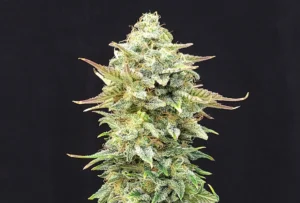


Trainwreck is a famous photoperiod cannabis strain known for vigorous growth, substantial yield potential, resinous flowers, and a distinctive combination of pine, earth, citrus, and sweet or spicy aromas. However, growers should know that Trainwreck is not represented by one completely standardized seed line.
Energetic, haze-leaning sativas bring a bright lift that many growers chase. If you want that in a quick plant, our Trainwreck Auto delivers a sharp, lemony-pine punch and a soaring head high on a fast autoflower, a good fit for anyone after an uplifting, daytime effect without a long flowering stretch.
Recommended Strains

Trainwreck

|
THC | 27% - 28% (High) |

|
Lineage | Mexican Sativa x Thai Sativa x Afghani Indica |

|
Type | Feminized |

|
Height | 6.07 ft | 1.85 m |

|
Yield | High |

|
Yield Indoor | 1.97 - 2.13 oz/ft² | 600 - 650 g/m² |

|
Flowering Time | 9 - 10 weeks |

|
Phenotype | 20% Indica / 80% Sativa |

|
Effects | Euphoric, Uplifted, Creative |

|
Flavors | Earthy, Pine, Sweet, Citrus |

Trainwreck Auto
|
|
THC | 22% - 23% (Medium) |
|
|
Lineage | Trainwreck x Ruderalis |
|
|
Type | Autoflowering |
|
|
Height | 3.28 ft | 1 m |
|
|
Yield | Medium |
|
|
Yield Indoor | 1.15 - 1.47 oz/ft² | 350 - 450 g/m² |
|
|
Life Cycle | 8 - 9 weeks |
|
|
Phenotype | 45% Indica / 55% Sativa |
|
|
Effects | Focused, Energetic, Happy, Powerful |
|
|
Flavors | Lemon, Pine, Spicy, Sweet |
Energetic, haze-leaning sativas are a joy to grow and even better to smoke. Nirvana’s Trainwreck delivers a sharp, lemony-pine punch and a soaring head high, while Super Sativa Seed Club’s Regular Prima Hollandica is a classic Dutch haze with a clean, uplifting effect. Both are long-flowering plants that reward patience with generous yields.
Growlantis currently carries multiple photoperiod Trainwreck lines with meaningfully different genetic ratios, THC levels, plant dimensions, and outdoor yield potential. One current line follows a Mexican Sativa × Thai Sativa × Afghani Indica background and is strongly Sativa dominant, while another preserves an Arcata, California Train Wreck line with a more Indica-leaning classification.
For that reason, this guide uses ranges where the current Trainwreck seed lines differ instead of presenting one set of specifications as universal.
Current Trainwreck lines generally flower for around 60–65 days indoors, produce approximately 650–700 g/m² under favorable indoor conditions, and finish outdoors from late September into early October. THC specifications across the available seed lines range from approximately 21.7% to 28%.
Growlantis currently carries an 80% Sativa Trainwreck seed line and a 60% Indica Trainwreck seed line. Check the exact product before applying one specific THC, height, yield, or genetic ratio to your grow.
Trainwreck Strain Grow Info
| Trait | Trainwreck |
|---|---|
| Seed type | Feminized photoperiod |
| Genetics | Vary by seed line |
| Indica / Sativa | Seed-line dependent |
| THC | Approximately 21.7–28% |
| Flowering time | Around 60–65 days |
| Indoor height | Around 100–150 cm where specified |
| Outdoor height | Up to around 3 m in taller lines |
| Indoor yield | Approximately 650–700 g/m² |
| Outdoor yield | Approximately 800–2,000 g/plant depending on line |
| Outdoor harvest | Late September to early October |
| Growth structure | Vigorous, branchy; some lines show vine-like growth |
| Common flavors | Pine, earthy, citrus, sweet and spicy |
| Reported effects | Euphoric, creative and energetic with varying physical relaxation |
These specifications are deliberately presented as ranges because Trainwreck seed lines sold under the same strain name do not all share identical cannabinoid levels, genetic ratios, height, or production figures.
What Is the Trainwreck Strain?
Trainwreck is a historic California-associated cannabis name that has been preserved and recreated through more than one commercial seed line.
Some modern Trainwreck seeds trace their stated genetics to Mexican and Thai Sativas combined with Afghani Indica. Other Trainwreck seeds are based on the famous clone-only Train Wreck associated with Arcata, California.
This distinction explains why growers can encounter apparently contradictory specifications while researching the strain. One Trainwreck product may be strongly Sativa dominant while another is classified as Indica leaning, yet both are sold legitimately under the Trainwreck name.
The characteristics that overlap more consistently are vigorous growth, substantial branching, high yield potential, a relatively short flowering period for a vigorous hybrid, and aromatic profiles centered around pine, earth, citrus, and related sharp or sweet notes.
Trainwreck Genetics
Trainwreck genetics depend on the exact seed line being grown.
One current version available through Growlantis is described as Mexican Sativa × Thai Sativa × Afghani Indica. This version has an 80% Sativa and 20% Indica profile.
Another current Trainwreck line is based on the legendary clone-only Arcata, California Train Wreck, rather than being presented as a new Mexican × Thai × Afghani seed cross. That line is classified as 60% Indica and 40% Sativa.
These differences are important because the Trainwreck name itself does not guarantee one identical genotype across every breeder or seed pack.
Growers should therefore confirm the exact Trainwreck product before using specific figures for THC, genetic ratio, height, or yield.
Is Trainwreck Indica or Sativa?
There is no single Indica/Sativa ratio that accurately describes every Trainwreck seed line currently sold through Growlantis.
One available photoperiod line is strongly Sativa dominant at approximately 80% Sativa and 20% Indica, while another is classified as approximately 60% Indica and 40% Sativa.
That difference is too large to reduce Trainwreck to a universal statement such as “Trainwreck is an 80% Sativa.”
The exact seed line should therefore be the reference when predicting growth structure or effect profile. What the current lines share more consistently is vigorous growth and a combination of mentally stimulating characteristics with varying levels of physical relaxation.
Trainwreck THC
Trainwreck THC also varies substantially between current seed lines.
Published specifications for the Trainwreck products available through Growlantis range from approximately 21.7% to 28% THC.
That means older descriptions stating that Trainwreck universally contains 18–22% THC are not appropriate for every current seed line, but neither should the higher 28% figure be applied to all Trainwreck products.
THC values describe genetic potential and reference testing rather than guaranteed results from every individual plant. Phenotype, lighting, environmental stability, plant health, harvest maturity, drying, curing, and laboratory methodology can all influence measured cannabinoid concentration.
Trainwreck Flowering Time
Current Trainwreck photoperiod seed lines generally flower for approximately 60–65 days indoors, or around nine weeks after flowering begins.
Some commercial descriptions round this figure to a broader nine-to-ten-week range, but the current breeder specifications for the Trainwreck lines available through Growlantis converge much more closely around nine weeks.
This flowering period begins after an indoor plant is switched to 12 hours of light and 12 hours of uninterrupted darkness.
It does not include germination or vegetative development.
Because Trainwreck is photoperiod dependent, growers can maintain vegetation for different lengths of time depending on available space, final plant size, root development, and training strategy.
Trainwreck Yield
Yield is one of Trainwreck’s strongest cultivation characteristics, but the exact figures depend heavily on the seed line.
Current indoor specifications fall around 650–700 g/m² under favorable conditions.
Outdoor production varies much more significantly. Published potential ranges from approximately 800 g per plant for one Trainwreck line to as much as 2,000 g per plant for another under suitable outdoor conditions.
These numbers should not be interpreted as guaranteed harvest weights.
Indoor production depends on lighting, canopy area, vegetative duration, plant density, root volume, training, nutrition, irrigation, and environmental stability. Outdoor yield additionally depends on sunlight, soil volume, climate, growing season, final plant size, and phenotype.
The large outdoor range is exactly why the seed line should always be checked before setting yield expectations.

Trainwreck Plant Height
Trainwreck is generally a vigorous plant capable of substantial stretch, but exact height varies by seed line.
One current line is specified at approximately 100–150 cm indoors and 150–300 cm outdoors. Another is described primarily through its vigorous, branchy, vine-like growth pattern rather than one precise official height range.
Indoor growers should therefore plan for meaningful vertical development rather than assuming Trainwreck will remain naturally compact.
Vegetative duration has a major influence on final size because this is a photoperiod strain. Training can also reduce vertical dominance and spread branches across a wider canopy.
Outdoors, early planting, large root systems, and strong sunlight can allow the most vigorous Trainwreck plants to become considerably larger than typical indoor specimens.
Growing Trainwreck Indoors
Trainwreck can perform very well indoors when its vigorous growth is managed from the vegetative stage onward.
An 18/6 photoperiod is a common option during vegetation. Once the canopy reaches the appropriate size for the available space, switching to 12/12 initiates flowering.
There is no universal four- or six-week vegetative period for Trainwreck. Growers should choose the switching point according to canopy size, available vertical clearance, root development, plant number, and training method.
Its strong branching makes canopy management particularly useful.
Because current Trainwreck lines can produce approximately 650–700 g/m² indoors, distributing productive branches across the available light is usually more useful than allowing one dominant stem to stretch far above the rest of the canopy.
Growing Trainwreck Outdoors
Trainwreck has strong outdoor potential and previously attracted particularly good search visibility for outdoor cultivation.
Choose a location with substantial direct sunlight, good drainage, and enough vertical and horizontal room for vigorous branch development.
Depending on the seed line and conditions, plants can become very large, with some current specifications reaching approximately three meters outdoors.
Large Trainwreck plants may also require structural support as flower weight increases. Stakes, ties, or trellising can help prevent long branches from bending excessively under mature buds or wind.
Outdoor production can range from approximately 800 g to 2,000 g per plant depending on seed line and growing conditions, so final plant size and root volume are major factors in harvest potential.
Trainwreck Outdoor Harvest Time
Current Trainwreck seed lines generally reach outdoor maturity between late September and early October in the Northern Hemisphere.
Some versions are listed around the third or fourth week of September, while others are normally ready at the beginning of October.
The exact date also depends on latitude, phenotype, seasonal temperatures, sunlight, and local weather.
Use the breeder window associated with the exact seed line as the primary planning reference.
As the expected harvest period approaches, confirm actual flower and trichome development rather than cutting automatically according to the calendar.
Outdoor growers should also monitor autumn rain and humidity closely as mature flowers gain density.
Germinating Trainwreck Seeds
Trainwreck does not require a unique strain-specific germination technique.
Seeds need stable warmth, consistent moisture, oxygen, and careful handling while the first root develops. A controlled moist paper-towel method or another suitable propagation method can work when conditions remain stable.
Keep the germination material moist rather than saturated.
Once the first root emerges, transfer the seed carefully into the growing medium and avoid damaging the exposed root tip.
Seedlings initially have small root systems and therefore require much less irrigation and nutrition than established plants.
For more detailed germination guidance, see how long cannabis seeds take to germinate.
Trainwreck Vegetative Growth
Trainwreck can develop rapidly during vegetation, producing strong vertical and lateral growth.
Indoor growers should use this stage to establish the plant structure they want before flowering begins rather than relying on a predetermined number of weeks.
A longer vegetative period produces a larger root system and canopy, but it also increases the amount of space required once flowering stretch begins.
This is therefore the best period for most structural training.
Branches remain flexible, plants have time to recover, and the canopy can be spread before dense flowers make repositioning more difficult.
The objective should be a well-spaced structure that allows strong light exposure and airflow across the productive growth sites.
Training Trainwreck
Training is particularly useful with Trainwreck because its vigorous branching can otherwise produce a tall and uneven canopy.
Low-Stress Training can be used to bend dominant branches outward and distribute growth horizontally.
Topping during healthy vegetative development can also reduce dominance of the main stem and encourage several productive branches.
Some Trainwreck lines have an especially vine-like growth habit and respond particularly well to a Screen of Green. A screen allows long branches to be trained horizontally, improving light distribution while reducing excessive vertical height.
Outdoor plants may require a different type of management. Large specimens often benefit more from branch support and sensible spacing than from trying to keep the entire plant compact.
Trainwreck Flowering Development
After the switch to 12/12, Trainwreck begins the transition into its approximately 60–65 day flowering period.
Some continued stretch can occur during early bloom, particularly in vigorous or more Sativa-expressive lines. Growers with limited headroom should account for that development before initiating flowering.
As bloom progresses, branches increasingly focus on dense resinous flower production.
The strain’s characteristic pine, earth, citrus, sweet, and sometimes spicy aromas become more pronounced as flowers mature.
Major structural training should be completed before late flowering. Once branches are carrying significant flower weight, support, stable environmental conditions, appropriate irrigation, and airflow become more useful than additional aggressive canopy manipulation.
Feeding Trainwreck
Trainwreck does not require one universal strain-specific NPK formula.
During vegetative growth, use an appropriate balanced nutrient program for the chosen growing medium that supports healthy roots, stems, and foliage.
As flowering becomes established, transition toward a suitable bloom-oriented program according to the fertilizer system being used.
High yield potential does not mean the plant automatically benefits from aggressive nutrient concentrations.
Nutrient strength should reflect substrate, water quality, plant size, root development, and actual response.
Monitor growth rate, leaf color, leaf tips, and general plant condition rather than treating one fixed feeding schedule as a genetic requirement of Trainwreck.
Watering Trainwreck
Trainwreck should be watered according to root-zone conditions rather than a fixed daily or weekly schedule.
Young plants use relatively little water because their root systems occupy only a limited area. Mature plants with large branch structures naturally consume significantly more.
Growing medium, container size, temperature, humidity, lighting, airflow, and root volume all influence how quickly moisture is used.
Allow enough oxygen to return to the root zone between irrigations rather than maintaining permanently saturated conditions.
Large outdoor plants can develop considerable water demand during warm periods, but good drainage remains important regardless of final size or yield potential.
Airflow and Branch Support
Trainwreck can produce substantial branching and increasingly dense flowers during late bloom.
Good airflow helps prevent stagnant pockets of moisture inside a large canopy. Indoor circulation should move air gently above, below, and through the branches while ventilation removes accumulated heat and humidity from the room.
Canopy organization during vegetation can make this much easier later.
Outdoor plants require similar attention after rain or during humid autumn conditions.
Long branches may also need support as flower weight increases, particularly on the larger outdoor expressions.
When to Harvest Trainwreck Indoors
Indoor Trainwreck plants generally approach maturity after approximately 60–65 days of flowering.
Use that range as a reference for when close inspection should begin rather than treating one particular day as an automatic harvest deadline.
Phenotype and growing conditions can produce small differences in finishing speed.
As the breeder window approaches, evaluate overall flower development and trichome maturity directly.
The most reliable harvest decision combines the specification attached to the exact seed line with the condition of the individual plant rather than relying only on a generic Trainwreck calendar.
Trainwreck Effects
The effect profile of Trainwreck can vary somewhat between seed lines, but current versions share several overlapping characteristics.
Euphoria, creativity, uplift, mental stimulation, and energy appear repeatedly across Trainwreck descriptions, while the physical component ranges from gentle relaxation to a considerably stronger body effect.
That variation makes sense given the significant difference in Indica/Sativa classification between available seed lines.
Individual responses can also differ according to dose, tolerance, phenotype, cannabinoid profile, and finished flower quality.
These characteristics should therefore be treated as general reported effects rather than guaranteed experiences or evidence that Trainwreck treats any medical condition.
Trainwreck Flavor and Aroma
Trainwreck is strongly associated with pine, earth, citrus, lemon, sweet, herbal, and spicy characteristics, although the precise balance changes between seed lines.
Pine and earthy notes appear particularly consistently, while citrus or lemon often adds a sharper aromatic component.
Some Trainwreck expressions also show sweeter, berry-like, skunky, herbal, or peppery elements.
Because Growlantis carries multiple Trainwreck lines, one universal dominant-terpene ranking should not be applied to every product without chemical analysis of the exact seed line.
The verified flavor and aroma ranges are more useful for a general Trainwreck guide.
Trainwreck vs Trainwreck Auto
Trainwreck photoperiod and Trainwreck Auto should not be treated as the same cultivation type.
The Trainwreck strains covered by this guide are feminized photoperiod plants. Indoor growers initiate flowering by changing the light cycle to 12/12, and the vegetative stage can be extended according to available space.
Trainwreck Auto contains autoflowering genetics and begins flowering according to age. It follows a much shorter overall lifecycle and has different height, yield, cannabinoid, and genetic specifications.
Growers should therefore confirm the exact seed type before using flowering times or cultivation schedules.
Common Problems When Growing Trainwreck
Assuming Every Trainwreck Has the Same Genetics
Trainwreck is not represented by one identical commercial seed line. Current Growlantis versions differ substantially in genetic ratio, THC, height, and outdoor yield. Always check the exact product specifications before applying one number universally to every Trainwreck plant sold under the same strain name.
Underestimating Plant Stretch
Trainwreck can develop vigorous vertical and lateral growth, especially when vegetation is extended. Indoor growers who fill all available headroom before the switch to 12/12 can struggle during flowering stretch. Early canopy training and appropriate timing of the photoperiod change make final height easier to control.
Using a Fixed Vegetative Calendar
Trainwreck is photoperiod dependent, so there is no universal four-to-six-week vegetative requirement. The grower controls when flowering begins indoors. Use canopy size, root development, available vertical space, plant number, and training strategy rather than the age of the plant alone to decide when to switch to 12/12.
Treating One Yield Figure as Universal
Current Trainwreck seed lines range from approximately 650–700 g/m² indoors and roughly 800–2,000 g per outdoor plant. Those differences reflect both genetics and plant size. Light, roots, climate, training, nutrition, irrigation, environment, and phenotype also have a major influence on actual harvest weight.
Assuming Trainwreck Is Mold-Proof
Some Trainwreck genetics are described as resilient, but that should not be interpreted as universal immunity to mold or mildew. Dense mature flowers, stagnant indoor air, prolonged rain, and high autumn humidity can still create problems. Good canopy spacing and airflow remain useful regardless of the exact seed line.
FAQs About Trainwreck Strain
How long does Trainwreck take to flower?
Trainwreck photoperiod seed lines currently sold through Growlantis generally flower for about 60–65 days indoors, which is roughly nine weeks after the switch to 12/12. Some listings round this to 9–10 weeks. Because Trainwreck is photoperiod dependent, this figure does not include germination or the grower-controlled vegetative stage.
How much does Trainwreck yield?
Trainwreck yield depends strongly on the exact seed line. Current Growlantis versions are associated with roughly 650–700 g/m² indoors, while published outdoor potential ranges from about 800 g to as much as 2,000 g per plant. Light, root space, plant size, climate, training, and phenotype determine actual production.
How tall does Trainwreck grow?
Trainwreck can stretch substantially, but height varies by seed line and environment. One current line is listed around 100–150 cm indoors and 150–300 cm outdoors, while another is described mainly by its vigorous, vine-like structure. Indoor growers should leave headroom and use training rather than assuming one universal final height.
Is Trainwreck indica or sativa?
There is no single universal Indica/Sativa ratio for every Trainwreck seed line sold through Growlantis. One current photoperiod line is 80% Sativa and 20% Indica, while another is 60% Indica and 40% Sativa. Check the exact product before using the ratio to predict growth structure or effects.
When is Trainwreck harvested outdoors?
Outdoor Trainwreck generally finishes from late September into early October in the Northern Hemisphere, depending on the exact seed line, latitude, phenotype, and seasonal conditions. Use that window for planning, but confirm actual flower and trichome maturity before harvest instead of cutting automatically on a fixed calendar date.
What is the THC level of Trainwreck?
THC varies considerably between the Trainwreck seed lines currently sold through Growlantis. Published figures range from about 21.7% to 28%, so one universal potency number would be misleading. Phenotype, environment, harvest maturity, drying, curing, and laboratory methodology can also influence the measured cannabinoid concentration of the finished flowers.